

You’ve got your ADHD diagnosis. Welcome to the club! 🙂 We have snacks, stickers, and go off on random tangents.
However you’re feeling about it right now, that’s a valid place to be. Relief, grief, validation, a strange kind of nothing, a dozen things cycling through in the space of an afternoon.
A diagnosis is a milestone.
It gives you language for things you’ve been living with, sometimes for decades. And that can stir up a lot in everyone. So there’s no ‘correct’ way to react to a diagnosis; all reactions are completely okay.
Still waiting for an assessment? Go check our post-referral resources here.
You arrive here carrying everything you’ve accumulated along the way.
This includes coping strategies that cost you, workarounds that kept you afloat, and relationships shaped by years of not having the ADHD context. That history doesn’t vanish with a diagnosis, and it’s an important part of your processing, as you’ll be able to see past experiences in a completely new light.
The weeks and months after diagnosis tend to come with rapidly shifting states: big feelings, unexpected grief, bursts of clarity, and days where nothing feels different at all. Both the intensity and the variation is normal for this phase of your life.
And in our experience, when this processing is supported, things settle faster and land in better places, whether that support is coaching, peer groups, reading, therapy, or some combination of these.
We’ve compiled our best resources below for this early part of life after diagnosis: start wherever makes sense for the headspace you’re in today.
And if you ever want to dive deep, have a look at our central ADHD page.
Our newly-diagnosed person’s Guide to ADHD, which includes presentations, common misconceptions debunked, co-occurring conditions, and the history of ADHD.
Pick your starting point[Hide][Show]
The single most important tip if you’ve just had an ADHD diagnosis
Before you do anything else, grab a piece of paper, write this down, then stick it somewhere you see every day:
You don’t have to take it in all at once.
ADHD is there in all aspects of your life, and there’s a lot of things you’ll learn about yourself, your exact traits, how they show up for you, what your needs are, and how you might want to accommodate them.
This is a lot. But you also have time to go through all of it.
So take this at your own pace. Dip in and out. Read a section when you’re ready. Bookmark this page in your browser so you don’t have to find your way back (old-school, but it works!).
“I want to understand what my diagnosis means”

“Will I still be myself after an ADHD / Autism diagnosis?”
You won’t lose yourself – in fact, most people find the opposite happens. As you gain clarity and self-compassion, drop the shame around your struggles, and learn to unmask more, you might discover you’re more yourself than ever before. You’ll finally get to meet the version of yourself that isn’t constantly performing, compensating, or apologising for existing.

“Do I have to tell people about my diagnosis?”
Your diagnosis is yours. You decide who hears about it and when. This post covers what you’re actually required to share about ADHD or Autism — at work, with the DVLA, with doctors — and what stays entirely with you.

“Will people judge me if they learn about my ADHD / Autism?”
People can still be mean, and your worries are valid. But research shows they’re already picking up on more than you think — and that disclosure often improves how they respond, not worsens it.
Get clear on ADHD traits
Your diagnostic letter probably lists traits in clinical language — “often fails to give close attention to details,” “often has difficulty awaiting turn.” These descriptions are written for clinicians, not for the person reading their own letter for the first time. The entries below translate the three ADHD presentations into something closer to daily life: what these traits actually look like when you’re living inside them.
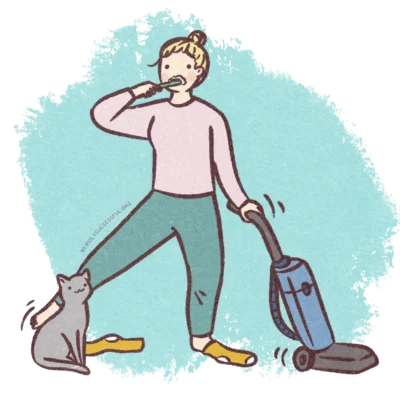
hyperactivity
Hyperactivity means a group of traits and is one of the ADHD subtypes. Hyperactivity can present in physical and mental symptoms. Hyperactive traits include fidgeting and other sensory-seeking behaviours, interrupting others when they talk or finishing their sentences for them, impulsive actions and thrill-seeking behaviour (with a reduced sense of danger), having many ideas and blurting them out.

impulsivity
Impulsivity describes a group of traits. In ADHD, it is characterized by a shortened pause between impulse and action: a bright flash that leads immediately to behaviour before you can fully consider it. Impulsivity shows up in different forms: verbal (blurting out, interrupting), emotional (expressing strong feelings immediately), decision-making (choosing immediate rewards over delayed ones), and motor (acting on physical urges).

inattentive
Inattentive traits are a trait cluster that represents one of the ADHD subtypes, also known as the distracted type. Inattentive traits include daydreaming, forgetfulness (not remembering the question while answering, forgetting things at home, following instructions with multiple sub-tasks), and difficulty focusing on a task that’s not engaging enough.
Other ADHD traits not part of the official diagnosis
Rejection Sensitivity Dysphoria (RSD)
Rejection Sensitivity Dysphoria (RSD) is an intense emotional and physical response to perceived rejection, criticism, or the fear of falling short — experienced by many neurodivergent people. The hot flash of shame, the spiral of “what did I do wrong,” the doomsday scenarios building while the other person is simply answering their front door — these are recognisable experiences for many people who grew up having their authentic selves ignored, dismissed, or misunderstood. RSD is a pattern recognition system shaped by real history, and having language for it means you can begin to watch the reaction rather than be yanked along by it.

emotional dysregulation
Emotional dysregulation is the inability to regulate the intensity and quality of emotions in order to generate an appropriate emotional response and return to an emotional baseline.
When someone has difficulty regulating their emotions, they are easily overstimulated and they can get upset or overwhelmed easily. On the other hand, they can also have trouble with calming down, relaxing, or decompressing and it takes much effort to regulate their mood.
From the outside, it might look like overreacting. From the inside, it feels like your nervous system is overwhelmed by emotional information your brain is struggling to process and modulate.
Concepts you might be familiar with
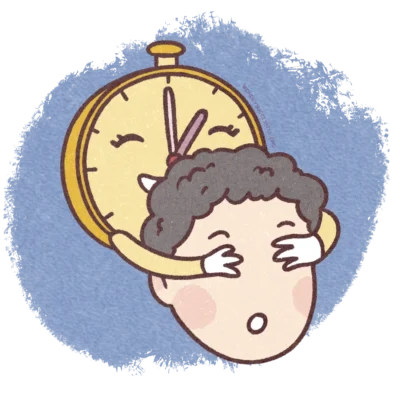
time blindness
Time blindness is when it’s tough to grasp the passing of time. It usually means you under- or overestimate the time a project will take. It makes it tricky to manage schedules, deadlines, and planning. It can lead to procrastination, forgetfulness, and feeling overwhelmed or rushed.

ADHD tax
ADHD tax is a casual term used to describe the additional costs, both tangible and intangible, that ADHD individuals often face due to their neurodivergence, especially struggles due to executive dysfunction.
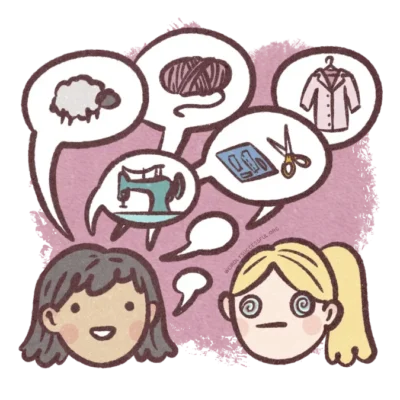
info dumping
Info dumping is the casual name referring to the act of sharing an extensive amount of information, usually about a subject or topic the person is extremely passionate about.
The biology behind ADHD
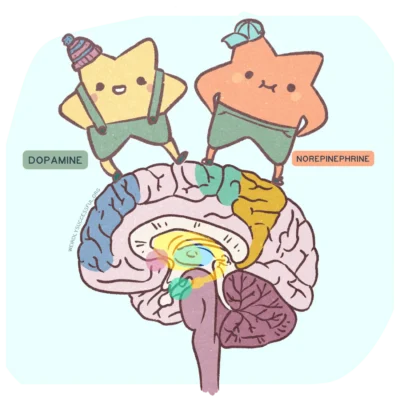
stimulant medication
Stimulant medications are the most commonly prescribed pharmacological treatment for ADHD. They work by increasing the availability of dopamine and norepinephrine in the brain, and have long-acting or short-acting variations. Stimulant medication has been in clinical use for over 80 years, they are safe and effective. Long-term users report mild or managable side-effects only.
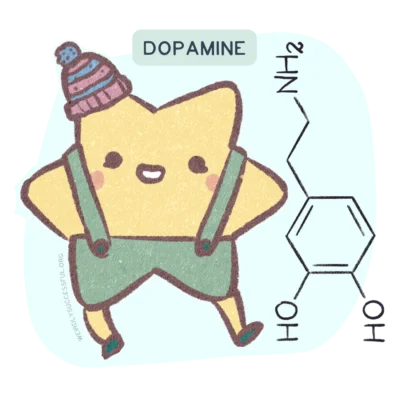
dopamine
Dopamine is a neurotransmitter involved in many different functions, including movement, motivation, reward, and pleasure. It is one of the most important neurotransmitters you have to get to know if you want to understand ADHD better.
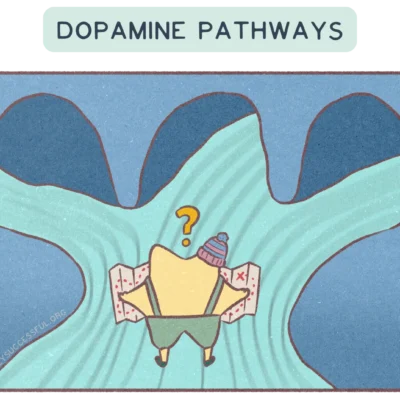
dopamine system
The dopamine system is the network of neurons, pathways, and chemical machinery that produces, delivers, uses, and recycles dopamine throughout the brain. It’s one of the most-discussed systems in ADHD, and with good reason — differences in how this system works are closely linked to difficulties with motivation, attention, reward, and the ability to sustain effort on tasks that aren’t immediately interesting.
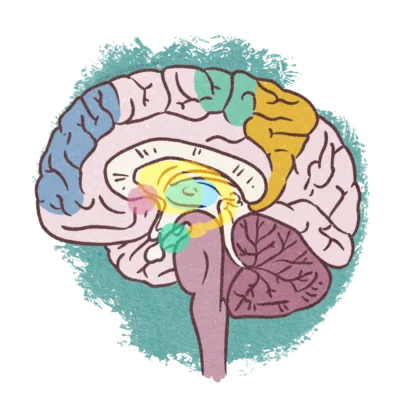
The neurodivergent brain
The brain is the organ behind every neurodivergent trait you experience — from how you pay attention to how you process emotion to how you sleep. Neurodivergent brains use the same basic structures and chemical messengers as any brain, but the tuning is different: different dopamine activity in reward circuits, different balance between excitatory and inhibitory signalling, different default mode network behaviour.
“I want to do something practical”
Explore common questions about living with ADHD





Figure out what works best for you

Make Your Life Neurodivergent-friendly with the Adaptation Explorer Workbook
Neurodivergent brains don’t come with universal solutions—what helps one person might not work for you at all. So if you’ve tried all the ADHD tips online, but nothing seems to stick, you’re not alone. Here’s how to discover your specific adaptations and create a life that actually works for YOUR brain. Explore your needs, what environments you work best in, what overwhelms you, and what helps you regulate.
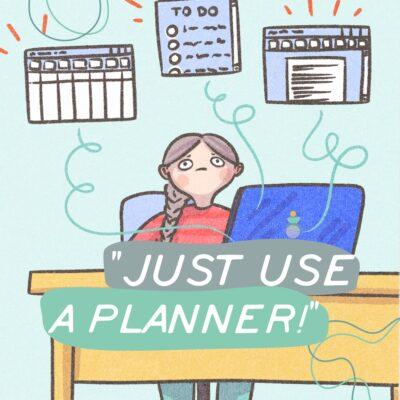
ADHD Planners: Bad advice, myths, solutions and best choices
One of the most common pieces of advice for people with ADHD is ‘just use a planner’. I’ve been using planners and notebooks since the age of 10, and as a neurodivergent person, let me tell you one thing: this advice, on its own, is bullsh*t.
How to spot if a product for ADHD is a rip-off: look out for these 10 red flags
Apps, productivity systems, quizzes for ADHD types, supplements, oh my! Not everything labelled with ADHD is actually good for ADHD.
In this article, we’ll show you how to tell if a product or service is just using ADHD as a buzzword for a quick cash grab.

 What do the ADHD self-assessment questions really mean?