


Decompressing is the process of recovering from the mental, emotional, and sensory load that piles up over the course of a day. It refers to engaging in activities or behaviours that allow a person to relax, unwind, and alleviate stress. This term is particularly significant in the neurodivergent community as we often experience heightened sensitivity to environmental stimuli, leading to increased stress and anxiety levels. Making sure to have time to decompress after especially taxing events is an essential part of self-care.
When you decompress, you give your brain and body the conditions they need to return to a manageable state after sustained effort, stimulation, or stress.
In casual language, for example, “I need to decompress after work“, it is usually used as a synonym for relaxation, but relaxation is just one form of decompression. And for many neurodivergent people, it’s not the most effective one.
Decompression is about restoring capacity:
- the ability to think clearly,
- regulate your emotions,
- process what’s coming in through your senses,
- and engage with the world without running on empty.
What builds that load differs from person to person. The usual suspects are long meetings, noisy commutes, an afternoon spent in sustained focus, or even a social event that required careful self-monitoring.
Each of these drains cognitive and emotional resources faster than they replenish, and the effects stack on top of each other throughout the day.
The need to decompress is the signal that those resources have run low and need restoring.
What does “decompress” mean?
Compression means placing immense pressure on something to make it smaller. Think of those vacuum-packed plushies or “boneless” couches – they suck the life out of them so they are small enough to ship.
Decompression refers to when this pressure is removed, and the object can slowly spring back to its natural state. Something similar happens to our brains too, which is why decompression also has a psychological meaning.
For neurodivergent people, that load often builds faster and from more sources. Masking adds to it, but so do sensory processing differences and the ongoing executive function demands of navigating systems designed around neurotypical defaults. This effort is invisible from the outside, even when it is overwhelming on the inside. No wonder that simplistic advice like “Just relax!” is impossible to do and just adds to the expectation pile of one more thing we cannot do on demand.
Table of Contents[Hide][Show]
How do you know if you need to decompress?
While the capacity drips slowly during the day, sometimes you don’t notice it how exhausted you are until you are at home in a safe place. It feels like you suddenly run on an empty tank because you don’t have to hold yourself together anymore. The version of yourself you’ve been performing all day stops mid-sentence, and you blink with a vacant stare. You might not have the energy to cook, to talk, to make a single decision about what to do next. All you know is you just need to stop. NOW.
For many neurodivergent people, this moment is the first honest moment since they left home earlier that day. The effort that preceded was invisible from the outside. Hours of reading social cues, filtering sensory input, managing executive function demands, and monitoring your own behaviour so it is deciphered the way people expect slowly drain your battery. Research on autistic masking describes this as rule-heavy mental work, closer to solving equations during a conversation than to natural social interaction.78
And this kind of effort doesn’t just make you tired that you can sleep off with a power nap. It drains you in ways that spill into the rest of your evening: simple things like eating, washing, or responding to a message can feel unmanageable after a day of sustained masking.78 Unfortunately, some of these things are often the ones that could replenish your batteries, but even doing these activities is too much exertion.
Other times it’s vaguer. You know something is off, but you can’t pinpoint what you need. You might feel restless and exhausted at the same time, or irritable without a clear reason.
Sometimes, the need to decompress is clear to you: you’re overstimulated, and you know it. You can point out that the lights are too much, the noise is too much, and everything coming through your senses feels abrasive.
Sensory overwhelm describes the state where incoming input exceeds your capacity to process it.
Emotional dysregulation describes the difficulty in managing the intensity of your emotional responses.
Both contribute to the load that decompression recovers from, and both make it harder to recognise the need for recovery in the first place.
Around three-quarters of autistic adults report this kind of interoception difficulty: trouble reading their body’s signals until those signals become extreme.26 The need to decompress can be one of those signals that’s hard to identify until you’re already past the point where gentle recovery would have been enough.
What builds the load
Every brain needs recovery time. Cognitive effort, sensory input, and emotional labour all draw on limited resources, and those resources deplete over the course of a day. This is true for everyone, not just neurodivergent people. When it comes to neurodivergence, the difference is in how many sources are drawing from the same pool at once, and how much of the effort is visible to anyone else.
Let’s take a work meeting, for example. For most people, the meeting takes cognitive effort: following the agenda, contributing ideas, staying focused. For a neurodivergent person in the same meeting, the cognitive demands might also include tracking the unspoken social rules of when to speak and when not to, filtering out the buzzing overhead lights or the colleague tapping their pen, managing the urge to fidget, and monitoring their own facial expressions so they come across as engaged rather than blank. It’s the same meeting for them as for the neurotypical colleague, but the processing cost is several times higher.
Research on autistic masking describes this extra layer as constant self-monitoring, cue reading, scripting, and behavioural adjustment.810 The effort is cognitive, but it’s also executive-functional: working memory, inhibition, and task-switching are all working overtime to maintain a performance that looks effortless from the outside.10 And this doesn’t happen during meetings: it runs all day, across every interaction, with no break in the processing load until you’re somewhere you can stop performing.
The same pattern of sustained suppression shows up across neurodivergent conditions, not just autism. Adults with ADHD are more likely to rely on emotional suppression as a regulation strategy, pushing responses down rather than processing them in the moment.30 Adults with Tourette syndrome report the same tendency: more frequent emotional suppression than their non-Tourette’s peers, with higher suppression linked to more depressive symptoms.41 The specific thing being suppressed differs across conditions, but the cost of sustaining that suppression follows the same pattern.
Autistic adults describe the reasons for masking as a mix of social survival, desire for connection, and fear of stigma.11 No matter what forces you to “perform neurotypicality”, masking takes a toll on everyone. And it can work in the short term: it grants social access and protection.8 But the cost of masking is always decompression, and even if you do not pay it in the moment, you are not avoiding it, just pushing it aside. It builds across hours and days, and the body eventually presents the bill if you don’t take care of it in time.
How decompression works
The recovery that happens during decompression works through two connected pathways. In research, these are called bottom-up and top-down regulation.
Bottom-up means the body leads: physiological changes like slower breathing, muscle release, and reduced heart rate send calming signals upward to the brain.
Top-down means the brain leads: cognitive and emotional shifts like reappraising, accepting, and reducing avoidance change how the body responds. Most decompression activities involve both, but different activities lean more heavily on one or the other.
In practice, this means that by understanding how your body regulates, you can consciously support the process.
You’re not waiting for recovery to happen on its own — you’re choosing activities that give your nervous system the input it needs to shift. You pick the activity; your body does the rest. Decompression works better when you understand what you’re helping your body do.
The bottom-up pathway is the more direct one. Slow breathing activates the vagus nerve, the main channel for parasympathetic nervous system activity, which lowers heart rate, reduces muscle tension, and shifts the body out of its alert state.2
This is the pathway that deep breathing exercises, progressive muscle relaxation, and some forms of gentle movement activate.
Your body has been holding tension, and by using these tools, you can help your body release that tension.
Is decompression the same as emotional regulation?
They’re related, but they work at different timescales. Emotional regulation is an in-the-moment process: you’re having an emotional response right now, and you’re managing it. Suppressing it, reappraising it, expressing it, redirecting it. It happens during the experience.
Decompression is what happens after. You spent the day regulating — emotionally, sensorily, cognitively, socially — and that sustained effort depleted your capacity. Decompression restores it so you can do it again tomorrow.
Decompression also serves more than emotional regulation alone. It replenishes sensory regulation, arousal regulation, cognitive regulation — all the systems that were drawing on the same limited pool throughout the day. It sits alongside emotional regulation, not inside it.
What connects them is that some decompression activities are regulatory tools. Deep breathing is autonomic regulation. Stimming is sensory regulation. Movement is arousal regulation. But with decompression, you’re not managing a response in the moment; you’re rebuilding the reserves that got spent, after the fact.
Bottom-up tools provide immediate relief, but top-down shifts are what change the patterns over time — they help with how you process stress tomorrow, not just how you recover from it today.
During effortful coping, your brain is running expensive programmes all day long: suppressing emotions, monitoring behaviour, staying hypervigilant to sensory input. These keep you functional in the moment, but they’re draining.
The top-down recovery process is where those programmes finally get to wind down. You start to let yourself feel what you’ve been holding back, reappraise situations rather than just endure them, and reduce the avoidance that builds up under sustained stress.34
Can decompression help with anxiety or depression?
The evidence is clearer on decompression helping with stress and anxiety than with depression.56
Relaxation-based approaches consistently reduce anxiety and stress-related symptoms, but the effects on depression are weaker and less consistent. The two states improve through different mechanisms — anxiety tends to ease when avoidance reduces, while low mood responds more to less rumination and more acceptance — which is part of why a strategy that helps with one may not help with the other.
So if you cannot “relax” and “meditate” and you feel like mindfulness exercises don’t do a thing for your depression, you are not doing it wrong. If what you’re carrying is closer to flatness, withdrawal, or persistent low mood, decompression alone may not be the right tool, and it’s worth exploring what else might help alongside it.
Why generic relaxation advice doesn’t do anything
The two recovery pathways (top-down and bottom-up) apply to all brains. For neurodivergent people, the same pathways operate, but the starting conditions are different, and this also determines what recovery needs to look like.
Your arousal baseline shapes what calms you down
ADHD brains often have difficulty reaching and maintaining an optimal level of arousal.1213 In research terms, arousal here means cortical activation: how alert, stimulated, and ready-to-go your brain is at any given moment. There’s an inverted-U relationship between arousal and performance: too little, and you can’t engage; too much, and you’re overwhelmed. Somewhere in the middle is where you function best.
For many people with ADHD, the resting baseline sits below that optimal middle point, particularly during slow, low-demand situations.12 When arousal is too low, the brain self-stimulates to compensate. Fidgeting, seeking out novelty, and physical restlessness come from this: they’re regulatory attempts, not misbehaviour.1213
For decompression, this has a direct practical consequence. If your arousal is too low, quiet stillness doesn’t restore you. It drops you further below optimal. Running, dancing, jumping, loud music — these are calming because they raise arousal to the level where your brain can settle. This is the opposite of what most relaxation advice assumes, and it’s why “just meditate” falls flat for a large portion of neurodivergent people.
At the same time, ADHD arousal profiles are not fixed. They shift with context, time of day, and how much has already been demanded of you.1516 The same person who needs vigorous movement after a slow, understimulating afternoon might need silence and darkness after a chaotic, overstimulating one. Recovery means moving toward optimal, whatever direction that requires.
Your sensory profile determines which inputs help and which ones hurt
Around 94% of autistic adults show extreme scores on at least one sensory processing domain, with wide variation in which domains are affected and how.17 Some people are hypersensitive to sound but seek out deep pressure. Others are undersensitive to movement but overwhelmed by visual clutter. These profiles are individual, and they shape what decompression can look like for each person.
Predictability and control improve how well someone can tolerate sensory input.18 A loud environment you choose is processed differently from one imposed on you. Decompression works better when the person has control over what’s happening to their senses, which is one reason prescribed relaxation environments (a group meditation room, a spa, a “calming space” someone else designed) can feel worse rather than better. Control is itself regulatory.21
Suppressing the body’s natural sensory regulation tools makes everything harder. Autistic adults describe stimming as a self-regulatory mechanism: a way to express emotion, redirect attention, and discharge sensory build-up.19 Being able to stim is associated with higher self-efficacy, and social pressure to suppress it worsens both emotional and cognitive regulation.2022 If decompression to you means being somewhere you can move, make noise, and use your body the way it needs to be used, then any environment that restricts those movements is working against recovery.
Decompression mechanics beyond autism and ADHD
Most of the research on sensory regulation and decompression focuses on autism and ADHD, but the underlying patterns appear across neurodivergent conditions.
In adults with dyspraxia, sensory over-responsiveness predicts coordination difficulties, but that relationship runs through emotion regulation rather than through sensory processing alone.36 The sensory load and the emotional cost of managing it are intertwined, and decompression needs to address both.
In adults with Tourette syndrome, reducing sympathetic arousal directly reduces tic frequency.40 Decompression in this context has a measurable physical outcome: calming the nervous system calms the tics. Combined with the finding that adults with Tourette’s use more emotional suppression throughout the day41, the picture is consistent with what shows up across other conditions: sustained suppression builds a load that recovery needs to address.
A meta-analysis across 33 studies found atypical sensory processing patterns across a wide range of neurodevelopmental and psychiatric presentations, not just autism.37 Adults with specific learning disabilities like dyslexia and dyscalculia show similar links between sensory processing patterns and executive function difficulties, particularly when they use passive rather than active self-regulation strategies.38
Decompression research hasn’t caught up with this breadth yet, but the underlying mechanism is still the same: if your nervous system processes the world differently, your recovery from that processing will look different too.
How to decompress as a neurodivergent person?
Decompressing activities can vary widely and depend on our needs for that day, interests or adaptations. Flexibility is key, and what works for one person might not work for another, and even the same person can have different preferences in different situations.
Decompression doesn’t have a single correct form. It depends on what drained you and how your body and brain need to recover. A useful framework for thinking about this comes from Dr Saundra Dalton-Smith, who identifies seven types of rest — physical, mental, emotional, sensory, creative, social, and spiritual — each addressing a different kind of depletion.1
Not every type will resonate equally with every person, and some are more helpful for neurodivergent people than others, but the framework gives you a starting point for identifying what you actually need rather than reaching for the same default every time.
1. Physical rest
The obvious version is sleep, stillness, and quiet. The less obvious version — and often the more useful one for neurodivergent people — is vigorous movement. Shaking your body, jumping, dancing, running, boxing, weight lifting; whatever gets you out of your head and into your limbs. If your arousal has been sitting below optimal all day, gentle rest drops it further. Movement raises it to the point where your brain can actually settle.
Restorative movement also belongs in this category, so think yoga, stretching, massage, or anything that releases the tension your body has been carrying. Deep pressure (weighted blankets, compression clothing, a heavy duvet, a large dog sitting on your lap) works through the same physiological pathway, providing proprioceptive input that helps the nervous system settle. You can also try humming or singing as a vocal release to regulate your nervous system and breathing.
Exercise in adults with ADHD is linked to better emotion regulation strategies and improved inhibitory control.3133 But the research also shows that the executive function difficulties that make decompression necessary can make structured exercise hard to sustain: forgetfulness, low motivation, and time-management stress all get in the way.32 The decompression version of physical rest doesn’t need to be a gym routine. It can be ten minutes of dancing in your kitchen, a brisk walk around the block, or throwing a ball against a wall. The threshold is much, much lower than fitness culture implies, so you don’t need to make your movement into a socially acceptable, Instagrammable #fitspo moment. Flail like an inflatable tube person to the theme song of The Sopranos – whatever works for you!
2. Mental rest
Mental rest means reducing the number of decisions, problems, and information streams your brain has to process. After a day of sustained cognitive effort, the most restorative thing is often not a stimulating activity but the absence of demand.
Routines and done-for-you options belong in the mental rest category. Meal prepping isn’t just time management: it removes the executive function load of deciding what to eat when your decision-making capacity is already spent. A default evening sequence (same show, same snack, same spot on the sofa) is a deliberate reduction in processing demand. For neurodivergent people whose executive function has been working overtime all day, removing decisions is a form of active recovery.
3. Emotional rest
Emotional rest is the space to stop holding things in. After hours of monitoring your responses, managing how you come across, and pushing down reactions that didn’t feel safe to express, emotional rest means letting that pressure release.
This can look like being somewhere you can cry, laugh, vent, or sit in silence without performing composure. You can sing loudly in the car or scream into a pillow. Emotional rest often overlaps with unmasking — dropping the social performance and letting your face, voice, and body do what they actually want to do. Masking research proves that sustained suppression builds a measurable emotional and cognitive cost,811 so it also needs to be replenished at one point.
4. Sensory rest
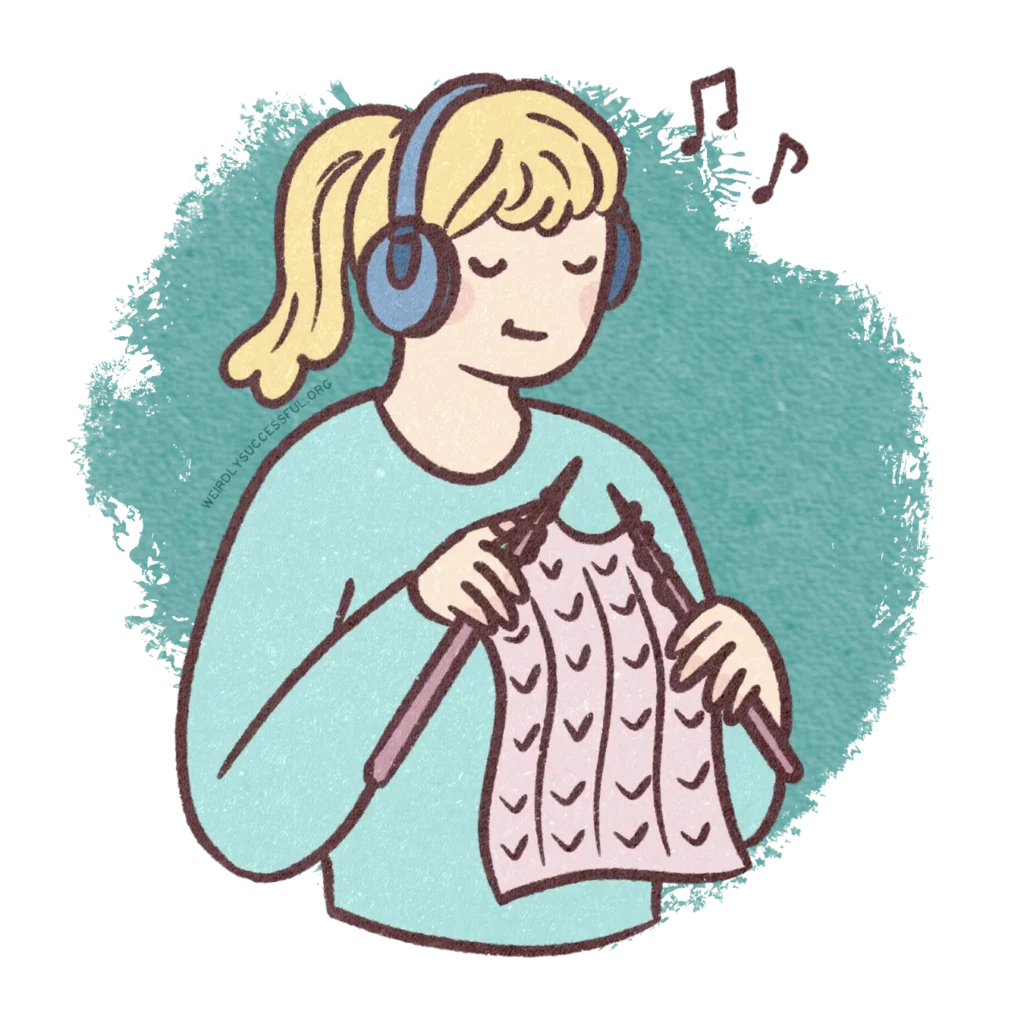
Sensory rest means reducing the input your senses have to process. An eye mask for complete darkness. Noise-cancelling headphones. A shower or bath in the dark for the sensory reset rather than the hygiene. Dimming the lights. Turning off screens.
But sensory rest can also mean replacing overwhelming input with soothing input. Individual sensory seeking profiles need different things: some people need silence, others need a specific kind of sound. Some find bright environments draining and dark ones restorative. Others need visual richness and find blank, sterile spaces unsettling. Research on calming spaces for autistic adults found that personalisation and control mattered more than any specific design — the same environment that soothes one person overwhelms another.21
Stimming sits at the border of sensory and physical rest, which just shows how important it is to find space for it in your self-care toolkit. It’s a way to discharge sensory build-up, redirect attention, and regulate emotion all at once.19 Being somewhere you can rock, flap, hum, or pace without judgement is itself a form of sensory decompression.
5. Creative rest
Creative rest means exposing yourself to things that inspire, delight, or restore a sense of wonder without any pressure to produce. A walk where you watch the trees or birds. Looking at art. Listening to music. Playing music badly and not caring. Doing something joyful and silly and pointless: colouring, building with Lego, making something with your hands that nobody will ever see. Spending time with your special interest, or “cozy hobbies”. Yes, even video games count if they help you express your creativity.
The restorative part of creativity is the absence of output pressure. If a creative activity starts turning into work (ideas forming, productivity instincts kicking in), notice that, write the idea down, leave it, and go back to play. You don’t need to document, monetise, or be perfect at the thing you are doing for it to count as creative rest.
6. Social rest
The obvious version of social rest is alone-time: not being anything for anyone, just being alone and processing for yourself.
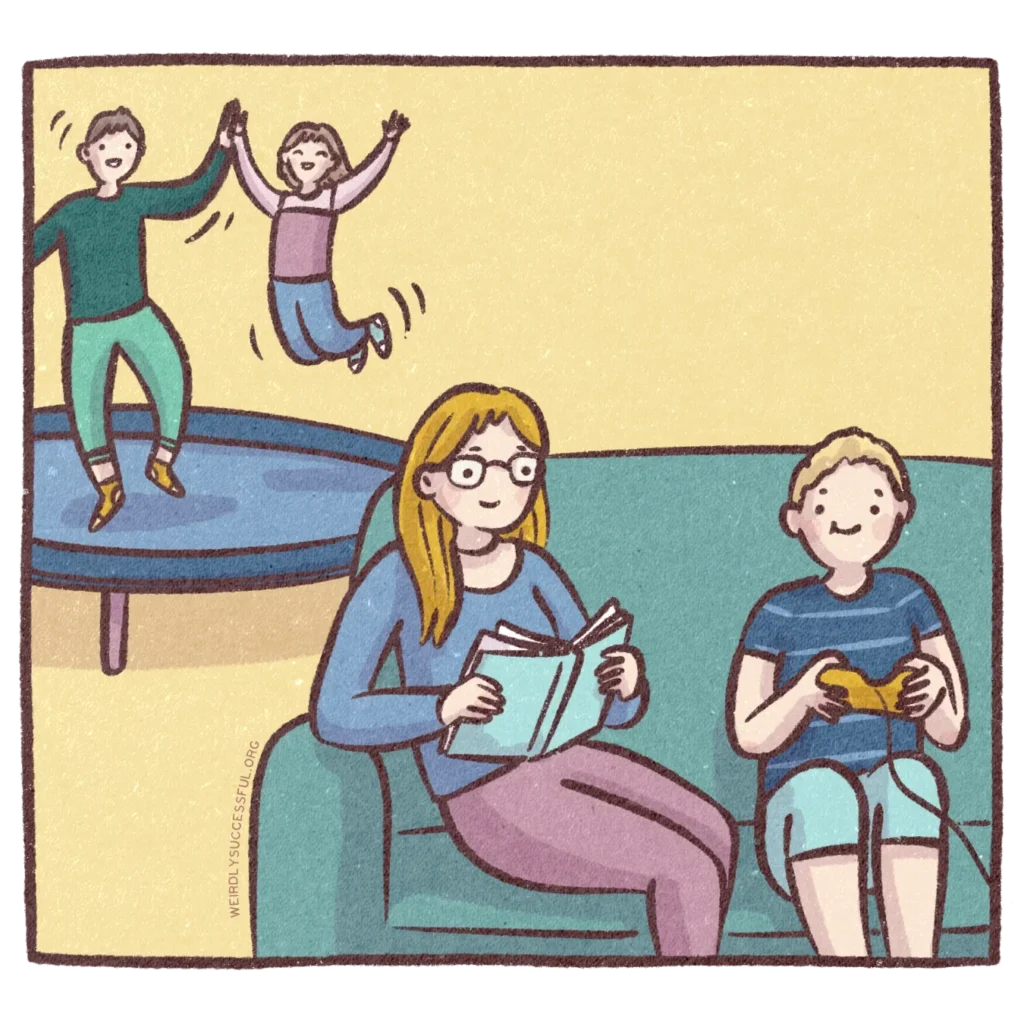
But social rest can also mean being with people around whom your nervous system can settle — people you don’t have to perform for, filter yourself around, or monitor your behaviour with. Draining social contact adds to the masking load, but safe social contact helps you to recharge.
Being around a calm, safe person can help your own nervous system regulate in ways that solitude cannot (this is called co-regulation). In attachment research, partner presence reduces neural threat responses more than being alone does.34 Your body can borrow stability from someone else’s settled state. For autistic people, inter-brain synchrony during social interaction may be reduced compared to non-autistic pairs35, which might explain why co-regulation feels harder to access. But the need for it is still there, it may just take different forms. Parallel presence or parallel-play rather than face-to-face conversation, shared activity rather than verbal processing, or simply being in the same room as someone safe without any expectation of interaction.
For some people, social rest means the opposite of quiet togetherness. They might recharge in fulfilling community settings: spinning together with 30 other people, singing loudly at a concert, or dancing through the night at a party. The social energy of a group can be regulating if it’s the right group in the right context. The key is that you’re choosing it rather than enduring it.
7. Spiritual rest
Spiritual rest means engaging with something that provides a sense of meaning or connection beyond the immediate demands of your day. This can be a religious or spiritual practice, but it doesn’t have to be. Meditation, journaling, drawing tarot or oracle cards, spending time in nature to marvel at the beauty, volunteering, or anything that connects you to something larger than your to-do list.
It is important to separate this from your day-to-day life: if you also find meaning in your work, spiritual rest needs to come from somewhere that isn’t your work.
Perfection, performance and expectations squash the restorative power of any type of rest.
Different days, different needs
One of the most frustrating things about decompression is that what works on Monday might not work on Wednesday. You found the perfect wind-down routine, it helped for two weeks, and then one evening it just… didn’t. You’re not doing it wrong. The need shifted because the depletion shifted.
The logic underneath is finding your complementer pairs. You look at what drained you and reach for its counterpart.
- If you spent the day hunched over spreadsheets, your body full of tension despite being exhausted, movement might release what stillness cannot.
- If you spent two evenings in a row at social events, you might need a day of saying nothing to anyone.
- If you stared at screens and data all day, something visually beautiful might be the thing that restores you: a gallery, a walk somewhere green, even just looking at something that isn’t a rectangle.
The pattern is simple once you see it: your recovery needs to be a different shape from the thing that depleted you. Physical depletion needs physical restoration. Sensory overload needs sensory quiet (or sensory replacement). Mental exhaustion needs mental stillness. Emotional suppression needs emotional release.
The seven types of rest give you categories to think with, and the complementer logic tells you which category to start with on any given day.
Build your own reset
What’s sometimes called a neurodivergent reset plan is the personalised version of this. If you create a flexible set of go-to strategies you’ve identified in advance, you’re not trying to figure out what you need in the moment when you’re already past capacity.
Reset routines often bundle recovery with preparation — clearing your desk, sorting your to-do list, setting yourself up for the week ahead. Those tasks are useful, but they require executive function, which is exactly what’s depleted. Decompression comes first because the practical tasks work better once you’re back at baseline.
“I can’t tell what I need”
Identifying what has depleted you is key to finding the replenishing activity, but many of us run into walls when it comes to figuring out what would help. You are not alone. Interoception — the ability to read your body’s internal signals — is an area of well-documented difficulty for many neurodivergent people. First-hand accounts from autistic adults describe limited awareness of hunger, thirst, pain, and fatigue.24 In one study, around three-quarters of autistic adults reported difficulty interpreting their body’s signals unless those signals were extreme.26
What makes this more complex is that the difficulty isn’t always about missing the signals. Some people pay more attention to their body’s signals than average, but interpret them less accurately, or interpret them more negatively.2728 You might feel something building all afternoon (restlessness, tightness, an untethered discomfort) without being able to decode what it’s asking for. By the time the signal is clear enough to read, you’re already past the point where simple “hacks” would have done the trick, and you need something more intensive to recover.
Difficulty reading bodily signals (interoception) and difficulty identifying emotions (alexithymia) often travel together, and this pattern is not exclusive to autism.29 It shows up across neurodivergent presentations and in people with histories of sustained stress or trauma.
Frameworks like the seven types of rest are useful precisely because they give you an external structure to reason from when your internal signals aren’t giving you clear information. Rather than waiting until you feel the need (which might not happen until crisis point), you can look at what you did today and work backwards: what type of resource did that draw on? What would replenish that type? It’s a thinking tool for the days when your body isn’t telling you what it needs.
Giving yourself permission
Decompression is easier to skip than almost any other form of self-care, because the need is invisible and the consequences are delayed, often happening when you are alone. You don’t collapse immediately, but you do get a little flatter, a little more reactive, a little less able to handle what comes next. You might notice built-up irritability, relationships that feel harder than they should, or the growing gap between what you want to do and what you can actually manage.
For neurodivergent people, there’s often an additional layer of guilt. You’ve been told your whole life that you should be able to handle things that other people seem to handle effortlessly. Taking time to recover from something that “shouldn’t” have been that hard can feel like proof that you’re not being a “proper adult”. Decompression, in this light, feels like an indulgence rather than a need. Just another notch in the “I am being difficult and hard maintenance” column. But even if we accept that you shouldn’t need to decompress in the first place (which I don’t accept, but let’s entertain this as a thought exercise), ignoring your needs doesn’t delete the fact that you do have them.
The load you carry all day is there, even if it’s the same as everyone else carries. The effort you spend is measurable, and more than that: it is measurable more than for other people. Therefore, the recovery your brain and body require is not optional. What this recovery will look like will not be set in stone: some days it will look like rest and stillness. Other days, it will look like movement and noise and mess. On some magical days, you’ll know exactly what you need; other days, you’ll have to experiment and see what helps.
All of that is fine and completely normal. Test what works, notice what doesn’t, adjust next time, and build up your toolkit. It doesn’t need to be working 100% of the time; you just need to do some of it, imperfectly.






 transitions