• Skip to main content
  • Skip to header right navigation
  • Skip to site footer
Weirdly Successful

Weirdly Successful

Dedicated to helping you understand, navigate and enjoy your weird & wonderful neurodivergent life.

  • About Us
    • The team
    • The mission
    • What we do
    • Events
  • Learn
    • Understanding Neurodivergence
    • Diagnosis & Assessment
    • Productivity & Planning
    • Sensory & Body
    • Emotions & Regulation
    • Health & Wellbeing
    • Work & Career
  • Free Resources
    • Latest Articles
    • Neurodivergent Glossary
    • Questions & Answers
    • Resource Library
  • Contact Us
    • Send a message
    • Book a Curiosity Call

rumination

stress thoughts
by
Weirdly Successful
Weirdly Successful (author)  

First published: 28 June, 2023 | Last edited: 28 March, 2026 || 📚🕒 Reading Time: < 1 minute ||

Ruminations are thought loops that you seemingly can’t get out of.

Examples: thinking about what you should’ve said 5 years ago, feeling anxious if they misunderstood you, or worrying about whether you should’ve behaved differently, did they judge you, whether you were in the wrong, etc. Can be present in both OCD or ADHD.
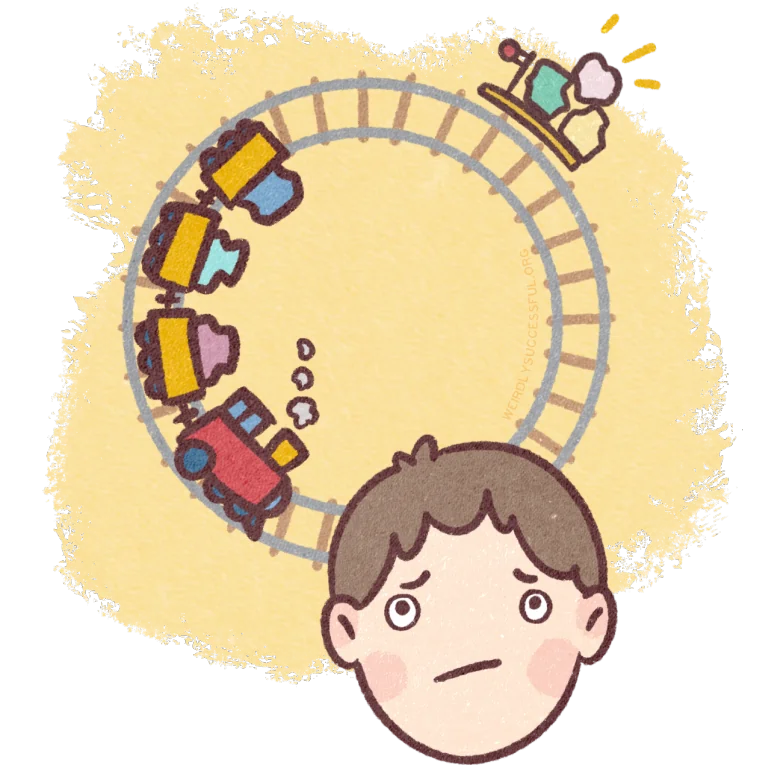
Rumination often functions as a desperate attempt to think your way to certainty. For people with a high intolerance of uncertainty, the brain keeps cycling through the same material because it cannot reach the resolution it needs to let the thought go.

Getting stuck in a thought loop is itself a form of cognitive inflexibility — the thinking can’t shift to a new perspective, release the topic, or accept that the issue might not have a clean resolution, so it keeps circling the same ground looking for one.

Related Questions

What's actually happening when I go into verbal shutdown?

communication language speech
Explore answer
« Back to the index

Related Terms

rigid thinking (cognitive inflexibility)

Cognitive inflexibility, also erroneously referred to as rigid thinking, is a diagnostic characteristic of autism that describes difficulty shifting between tasks, perspectives, or plans. The label captures how the trait looks from outside — but the internal experience is better understood through monotropism: a processing style that goes deep rather than wide. The depth that makes sustained focus, thoroughness, and reliability possible is the same depth that makes switching costly. The difficulty and the strength are the same mechanism.

Learn more
communication emotions energy focus motivation
intolerance of uncertainty

Intolerance of uncertainty (IU) describes the degree to which a nervous system needs predictability in order to function — not as a preference, but as a genuine operational requirement. When outcomes are unknown or plans unconfirmed, a high-IU nervous system tends to generate contingencies: running through variables, gathering information in advance, and finding it difficult to settle until enough is known. For many autistic and ADHD adults, IU runs at a higher baseline than in the general population, and shows up in everyday experiences like needing to know the plan before you can be present, finding plan changes disproportionately disruptive, or preparing carefully for situations in order to free up bandwidth to actually enjoy them. It's not about rigidity or control — it's a nervous system requesting the information it needs to work properly.

Learn more
communication self-regulation support
restricted repetitive behaviours (RRBs)

Restricted Repetitive Behaviours (RRBs) is the clinical term for a broad group of autistic traits including stimming, echolalia, routines, persistent interests, and sensory sensitivities. Despite the pathologising name, these patterns serve real purposes — self-regulation, cognitive energy conservation, and genuine enjoyment. They are how an autistic nervous system manages a world that doesn't come with enough predictability built in.

Learn more
joy self-regulation sensory
Rejection Sensitivity Dysphoria (RSD)

Rejection Sensitivity Dysphoria (RSD) is an intense emotional and physical response to perceived rejection, criticism, or the fear of falling short — experienced by many neurodivergent people. The hot flash of shame, the spiral of "what did I do wrong," the doomsday scenarios building while the other person is simply answering their front door — these are recognisable experiences for many people who grew up having their authentic selves ignored, dismissed, or misunderstood. RSD is a pattern recognition system shaped by real history, and having language for it means you can begin to watch the reaction rather than be yanked along by it.

Learn more
communication pain relationships self-regulation
justice sensitivity

Justice sensitivity is the heightened awareness of rule violations and inconsistencies, paired with an intense emotional and physiological response. For many neurodivergent people, fairness and consistency function as essential navigational tools when you can't reliably read social cues or predict what will happen next. When rules are applied inconsistently or stated expectations don't match actual consequences, your nervous system registers this as a genuine threat to your ability to navigate the world safely. The intensity of your reaction reflects the pattern violation itself, regardless of the moral weight of the situation. Justice sensitivity is morally neutral—it tells you when a rule has been violated, but not whether the rule was good or fair in the first place.

Learn more
communication emotions self-image society
cognitive load

Cognitive load refers to the total amount of mental effort being used at any given time. For neurodivergent people, activities that others might find automatic (like maintaining expected facial expressions or processing background noise) can significantly increase cognitive load.

Learn more
focus information
Previous Post:sensory overwhelm
Next Post:neurodiversity

About the Author

  • Weirdly Successful

    Weirdly Successful

    A 100% neurodivergent team — Adam Dobay, Livia Farkas and Nora Selmeczi — bringing together lived experience, adult education expertise, clinical training and NHS co-production to create friendly, science-backed resources that help neurodivergent adults figure out what actually works for them

    View all posts

Free Resources for Neurodivergent Adults

Get our research-backed, experience-validated strategies & guides for a neurodivergent work & life that you can adapt to what success looks like to you.

Create a free account to get your goodies!

Is the button not working? No worries!
Sometimes ad-blocks stop all pop-ups, even if they are not ads.
This might be the case if nothing happens when you click the button.
Here’s another, non-pop-up way to sign up, please try if this works!

By signing up you allow us to send you Weirdly Successful’s newsletter with practical tips, strategies, and optional training material.
You can unsubscribe any time. Our Privacy Policy makes for a great summer reading!

Weirdly Successful is a 100% neurodivergent-run non-profit, developing strategies & frameworks for neurodivergent adults.

  • E-mail
  • Instagram
  • Mastodon
  • Tumblr
  • Pinterest

DISCLAIMER: All content on this website is for informational purposes only, and does not substitute for medical advice. For medical advice, diagnosis or treatment, consult a medical professional or healthcare provider.

While we strive to represent up-to-date and scientifically accurate information, our authors are not medical professionals unless where specifically noted. All opinions are the authors’ own.

Weirdly Successful’s authors and collaborators are not liable for risks or issues
associated with using or acting upon the information on our site.

All original content Copyright © 2026 · Weirdly Successful · All Rights Reserved.

Privacy Policy