

Hey ,
Log in with your WS Library account, and you can start saving glossary entries, articles and other content on the website for later!
Top 5 Glossary entries bookmarked by the community
-
1
autistic direct communication
Direct communication is a pared-down, efficient way of speaking, where the words mean what they mean — no subtext to decode, no softening layer to read past. For many autistic people, this is the default register. It often gets misread as bluntness or aggression, but the directness is usually doing precision work.
2 -
2
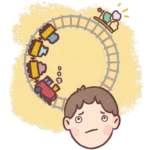
rumination
A rumination is a thought or a group of thoughts that get stuck in your head and loop over and over again whether you want it to or not (and you usually don’t). Ruminations get their name from ruminant animals who of animals It can be very difficult to move on from them. Ruminative thoughts …
2 -
3

justice sensitivity
Justice sensitivity is the heightened awareness of rule violations and inconsistencies, paired with an intense emotional and physiological response. For many neurodivergent people, fairness and consistency function as essential navigational tools when you can't reliably read social cues or predict what will happen next. When rules are applied inconsistently or stated expectations don't match actual consequences, your nervous system registers this as a genuine threat to your ability to navigate the world safely. The intensity of your reaction reflects the pattern violation itself, regardless of the moral weight of the situation. Justice sensitivity is morally neutral—it tells you when a rule has been violated, but not whether the rule was good or fair in the first place.
2 -
4
inertia
Inertia is the experience of being unable to start (or stop) an activity despite wanting to, a difficulty of task initiation or task paralysis. It's a common neurodivergent experience related to executive function, and not caused by laziness, procrastination or lack of motivation. Like a car without fuel, no amount of pressing the gas pedal will help when the resources needed for action aren't available.
1 -
5
literal thinking
Literal thinking is a precision-oriented processing style common in autistic people, where words, questions, and instructions are interpreted according to their exact meaning rather than their implied or intended meaning. It is one of the most commonly misunderstood autistic traits — both by neurotypical people who assume it means autistic people cannot grasp metaphors or jokes, and by autistic people themselves who dismiss it because they understand figurative language perfectly well. Many autistic adults comprehend metaphors, sarcasm, and idioms with ease, but still respond very precisely to the literal content of questions, miss the unstated social layer attached to a comment, or get stuck on vague terms like "often" that don't contain enough information for an accurate answer. Literal thinking shows up most clearly when communication leaves gaps that the listener is expected to fill in — and it becomes far less of a factor when the information provided is clear, specific, and explicit.
1 -
6
rigid thinking (cognitive inflexibility)
Cognitive inflexibility, also erroneously referred to as rigid thinking, is a diagnostic characteristic of autism that describes difficulty shifting between tasks, perspectives, or plans. The label captures how the trait looks from outside — but the internal experience is better understood through monotropism: a processing style that goes deep rather than wide. The depth that makes sustained focus, thoroughness, and reliability possible is the same depth that makes switching costly. The difficulty and the strength are the same mechanism.
1 -
7
auditory stimming
Auditory stimming is a form of self-stimulatory behaviour that involves making sounds with your voice, whether through non-word vocalisations (vocal stimming) or speech-based expressions (verbal stimming). This natural and beneficial form of self-expression helps with emotional regulation, sensory processing, and achieving a sense of comfort and focus.
1 -
8
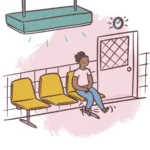
fidgeting
Fidgeting involves small, often unconscious movements—bouncing your leg, tapping your fingers, clicking a pen, doodling, twirling your hair. These movements help regulate focus and discharge energy, particularly for people with ADHD. Fidgeting provides the sensory input your brain needs to stay alert and engaged, especially during tasks that don't provide enough stimulation on their own. It's about maintaining the right level of arousal (alertness) to concentrate or releasing restless energy when big movements aren't possible.
1 -
9
hypervigilance
Hypervigilance is a state of heightened, sustained alertness where your nervous system stays oriented toward detecting threat, even when no real danger is present. It can feel like being permanently on-edge, bracing for something you can't name. In neurodivergent adults, hypervigilance often extends beyond physical danger into social monitoring: tracking unspoken rules, reading tone, watching for signs you've got it wrong. It is a human response, not a neurodivergent one, but it shows up with particular frequency and particular cost in autistic and ADHD adults.
1 -
10
gut-brain axis
The gut-brain axis is the two-way communication system between your digestive tract and your brain. It runs on nerves, neurotransmitters, immune signals, and microbial chemistry, and it's a large part of the reason why so many neurodivergent people have persistent stomach problems which are often not even connected to their neurodivergence.
1