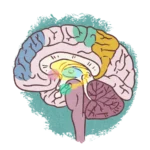

Synaptic pruning is the process by which the brain refines its connections during development, removing synapses that are used less frequently while strengthening active ones. In autistic brains, this process works differently — two independent cleanup systems (the neuron’s internal recycling programme and the brain’s specialised immune cells) are both less aggressive, meaning significantly more connections are retained. This denser wiring contributes to many recognisable autistic experiences: sensory intensity, deep focus, rich pattern recognition, difficulty filtering, and the challenge of switching between tasks or environments.
Every brain starts life with far more connections than it will eventually keep. During infancy and early childhood, neurons form synapses — the contact points where they communicate with each other — at an extraordinary rate. A toddler’s brain contains roughly twice as many synaptic connections as an adult’s. This is by design. The brain overproduces connections first, and then spends the next two decades refining them.
What is synaptic pruning?
This refinement process is called synaptic pruning (sometimes called neural pruning). It works on a “use it or lose it” basis: connections that are frequently active get strengthened, while those that see less use are gradually dismantled. The process is most intense during early childhood and adolescence, and continues into the mid-twenties — particularly in the prefrontal cortex, which handles planning, decision-making, and social reasoning.12
Two systems handle this cleanup work. The first is internal: neurons have their own recycling programme called autophagy, which breaks down and clears out components the cell no longer needs, including the physical structures where synapses live (dendritic spines). The second is external: specialised immune cells called microglia patrol the brain, identify synapses tagged for removal, and physically engulf them.23
In a typical brain, these two systems working together result in a streamlined, efficient network — fewer connections, but faster and more targeted communication between brain regions.
How synaptic pruning works differently in autistic brains
In autistic brains, both of these cleanup systems work differently. The internal recycling programme is suppressed by an overactive signalling pathway called mTOR, which acts as a kind of growth-and-maintenance regulator for cells. When mTOR runs too hot — which research suggests it does in the majority of autistic brains — it tips the balance toward building and away from recycling, meaning neurons can’t clear out unused synapses as effectively.4 At the same time, the external cleanup crew (microglia) appears to be less aggressive at identifying and removing tagged synapses, possibly due to disruptions in the immune signalling system that guides them.25
The result is that autistic brains retain significantly more synaptic connections than neurotypical brains. One landmark study found that while neurotypical brains lose roughly half their synaptic connections by late childhood, autistic brains lose only about 16% — a dramatic difference in density.4 This has been observed particularly in the frontal, temporal, and parietal cortices — areas responsible for planning, language processing, sensory integration, and body awareness.267
These connections aren’t being chosen for retention. They’re surviving by default because the removal process works differently. But the outcome is something like living in a house where the decluttering system doesn’t quite function as expected. Things accumulate — not because every item was consciously valued, but because the process that would normally clear them out isn’t as aggressive. The result is a richer, denser archive. Sometimes you find extraordinary connections between things you kept that others would have thrown away. Sometimes you can’t find what you need because there’s so much to navigate. Often, both of these things are true at the same time.
What this can look and feel like
The extra connections in autistic brains tend to increase local connectivity — richer processing within a brain region — while potentially reducing the efficiency of long-range communication between distant regions.68 This pattern, sometimes described as local hyperconnectivity with long-range hypoconnectivity, shows up in daily life in ways that will be familiar to many autistic people.
Sensory intensity. More connections in sensory processing areas means more incoming signal actually gets processed. The hum of a fluorescent light, a texture against your skin, the background noise in a café — these aren’t being imagined or exaggerated. Your brain is genuinely registering more sensory information than a neurotypical brain would in the same environment. This is part of what makes sensory sensitivities and difficulties with habituation — the process of tuning out repeated stimuli — such a consistent part of autistic experience.
Deep focus and pattern recognition. Intense local processing within a brain region can look like the ability to go very deep into a subject, notice patterns others miss, or make connections between ideas that seem unrelated to people around you. The experience of being drawn into something so completely that time disappears is partly a feature of this wiring — richly interconnected local circuits that sustain attention within a domain. This connects to what researchers describe as monotropism and what many autistic people recognise as their special interests.
Difficulty with transitions and switching. If local connections are rich but long-range communication between regions is less efficient, shifting from one activity or mental state to another requires more effort. This isn’t a motivation problem — it’s a connectivity one. The signals that would typically help the brain shift gears smoothly have more noise to travel through. Transitions and cognitive inflexibility have neurological roots that go deeper than habit or preference.
Filtering and overwhelm. A brain that retains more connections is also a brain with a higher baseline of internal activity. The process of filtering out irrelevant information — deciding what to attend to and what to ignore — relies on the efficient pruning of pathways that carry non-essential signals. When more pathways remain active, the filtering task becomes harder. This contributes to the experience of decision fatigue, sensory overwhelm, and the feeling of your brain being “noisy” — not because something is wrong, but because there is genuinely more happening in there.
There’s no clean way to separate the enriching aspects of this from the overwhelming ones, because they come from the same source. The vivid sensory world, the deep interests, the unexpected connections, and the overwhelm, the difficulty filtering, the exhaustion of processing so much — these are all expressions of the same underlying architecture. Acknowledging both is more honest than pretending it’s all a superpower or all a deficit.
What about ADHD?
Most of the research on synaptic pruning differences comes from autism-specific studies. The evidence for ADHD is thinner — one key review suggests that ADHD involves milder but persistent differences in circuit refinement throughout childhood, more like a subtle delay in the pruning timeline than the pronounced under-pruning observed in autism.9 Imaging studies have found patterns consistent with delayed cortical maturation rather than dramatically increased synapse density.9
This is worth noting for the many people who have both ADHD and autism (AuDHD), where the two patterns may interact in ways that research hasn’t fully mapped yet. It also reflects a broader gap in the field: ADHD has received far less attention than autism in the neurodevelopmental pruning literature, and the absence of evidence is not the same as evidence of absence. If the research base grows, this section will grow with it.
The bigger picture
Synaptic pruning is one piece of a larger neurodevelopmental picture. The same pathway that affects pruning — mTOR — also influences sensory processing, learning and memory consolidation, the balance between excitatory and inhibitory brain signalling, and the strength of connections in social and reward circuits. Many of the autistic experiences that have historically been treated as separate “symptoms” may share deeper biological roots than previously understood. The mTOR entry explores this in more detail for those who want to follow that thread.
« Back to the index