


Fidgeting is what happens when your ADHD or autistic brain uses small, often unconscious movements to regulate focus and discharge energy.
You might not even notice you’re bouncing your leg, doodling in the margins, or twirling your hair until you’ve been doing it for a while, because your brain is busy focusing on the actual task, rather than on sitting still.
The buzzy energy that often comes with ADHD and autism has to go somewhere: either it circles internally in your head, making it harder to concentrate, or it moves outward through your body. When big movements like pacing or standing aren’t appropriate (during a meeting, lecture, or phone call), small movements take their place. These aren’t distractions from focus, quite the opposite: for many ADHD and autistic people, they’re how focus happens.1
In clinical settings, fidgeting may be described as motor restlessness, repetitive motor behaviour, or psychomotor activity, so don’t get alarmed if you read this in your assessment document; they just mean fidgeting. 🙂
How Fidgeting Helps in ADHD
If you force yourself to sit completely still, all your mental energy goes into not moving, leaving nothing left for listening or thinking. For ADHD brains, this creates an impossible trade-off: you can either sit still or pay attention, but often not both at the same time. The reason comes down to arousal regulation.
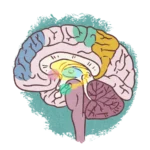
The mechanism behind fidgeting’s effectiveness comes down to neurotransmitters. Physical activity (even something as small as fidgeting your hands or bouncing your leg) increases levels of dopamine and norepinephrine in the prefrontal cortex, the same neurotransmitters that ADHD medications target.3 These chemicals play a key role in sharpening focus and sustaining attention, which is why movement can feel necessary rather than optional when you’re trying to concentrate.
A Note on “Arousal”
In neuroscience, arousal refers to your brain’s level of alertness and readiness to engage with the world around you. It’s about how awake, alert, and activated your nervous system is, and it has nothing to do with sexual arousal. When we talk about ADHD brains being “under-aroused,” we mean they’re running at a lower baseline level of alertness, which makes it harder to engage with tasks that don’t provide enough stimulation.
Research backs this up: adults with ADHD show increased fidgeting during correct trials on cognitive tasks, and fidgeting increases as tasks progress and attention naturally becomes harder to maintain.1 Another research on lecture retention found that the longer people spent listening, the more their attention and retention declined, whilst fidgeting increased, suggesting fidgeting rises as a compensatory mechanism when focus begins to wane.6.
This suggests fidgeting helps maintain focus and regulation, particularly during tasks that require sustained attention.4 Fidgeting increased blood flow to the prefrontal cortex during decision-making tasks, providing direct brain imaging evidence of how movement enhances cognitive function.5
Even specific types of fidgeting show measurable benefits: people who doodled while listening to a dull phone message had 29% better recall compared to those who didn’t, because keeping hands busy frees up working memory and removes the mental interference of boredom and restlessness.2
Fidgeting sits in an interesting overlap between stimming and hyperactivity, and contextualising it as part of restricted repetitive behaviours helps reframe it from “disruptive habit” to what it usually is: a regulatory mechanism the body uses to manage arousal, attention, or sensory input.
What does fidgeting do to ADHD brains?
Fidgeting serves different purposes depending on what your brain needs in the moment.
When you’re understimulated (while sitting through a boring presentation or trying to focus on paperwork), fidgeting helps boost your arousal level so you can engage with the task.
And when you have excess energy (or are in a hyperactive mood) but can’t move in big ways, fidgeting provides an outlet: tapping a pen during a meeting, running your fingertips over a textured surface, crocheting during a lecture. And sometimes fidgeting even increases during periods of intense focus, as if the effort of concentrating generates its own need for movement.

People with ADHD use movement to keep themselves alert, and have a harder time sitting still unless they’re in a highly stimulating environment where they don’t need to use much working memory.7 Fidgeting provides the sensory input your brain needs to stay alert and engaged, offering calming tactile or proprioceptive feedback that helps regulate attention and arousal states.
The same behaviour can serve multiple functions. Doodling during a video call might help you stay alert when the content is dry, discharge restless energy when you’d rather be pacing, and support your concentration all at once. What matters is that the movement is happening in the background, not demanding your attention the way a fidget spinner or complex toy might.
Fidgeting and anxiety
Fidgeting and restless movements appear as questions in anxiety assessments like the Generalised Anxiety Disorder scale (GAD-7), which can create confusion for people with ADHD. These assessments often assume that “anyone who fidgets must be anxious“.
For ADHDers, anxiety can certainly make fidgeting increase. And when you’re anxious and have ADHD, the fidgeting might intensify. But fidgeting being present at all doesn’t mean anxiety is present. It’s a baseline feature of how many ADHD brains regulate focus and energy, not necessarily a sign of emotional distress.
So if you are an ADHDer and fidgeting is just a regular Tuesday for you, when faced with such a question, answer it compared to your baseline: are you fidgeting more than usual?
“Sit still and pay attention!” Okay, pick one!
From the outside, fidgeting looks like inattention. Teachers and parents often interpret movement as a sign someone isn’t listening, and many ADHD adults grew up being told to “sit still and pay attention” as if those two things naturally go together. But for ADHD brains, they often don’t.
Requiring complete stillness is what causes inattention. All available mental energy goes towards the effort of not moving, leaving nothing for the actual task.
The irony is that someone sitting perfectly still might look focused, but they could be daydreaming, zoning out, or exhausting themselves trying not to move. Meanwhile, the person doodling, bouncing their leg, or knitting during a lecture might be the one absorbing every word. What appears to be a distraction from the outside is often deep engagement from the inside.
Allowing fidgeting means someone can listen more intently, even though it looks like the opposite.
Fidgeting Is Functional
Fidgeting is okay. More than okay, it is necessary — for children, for adults, for anyone whose brain works better with movement.
If a child is doodling during a lesson but can answer questions about the material, or an adult is crocheting during a meeting but contributing meaningfully to the discussion, the fidgeting is doing its job. Teachers and parents shouldn’t punish children for fidgeting simply because it looks “inappropriate” or doesn’t match expectations of how focus should appear, especially when it’s not hurting their performance or disrupting others.
Let them doodle if it helps them listen. Let them bounce their leg if it helps them think. The goal is engagement and learning, not compliance with an arbitrary standard of stillness that may actually undermine the very focus we’re trying to support.






 “Why do people fidget when they are hyperactive?”