


What is dopamine?
Dopamine is a neurotransmitter, a chemical messenger your brain uses to send signals between neurons. It’s involved in motivation, reward, attention, movement, emotional regulation, pain processing, and learning. If you’ve looked into ADHD at all, you’ve encountered dopamine, because differences in how the dopamine system works are at the centre of most ADHD research and most ADHD medication. It is one of the most important neurotransmitters you have to get to know if you want to understand ADHD better.
But dopamine has a reputation problem. It gets called the “feel-good chemical,” the “reward molecule,” the thing you’re supposed to “hack”, “detox” from, or “boost” with the right supplement. Most of these descriptions are either oversimplified or wrong, and they lead to advice that doesn’t work — or worse, to self-blame when the advice predictably fails.
We’re going to cover what dopamine actually does, what it doesn’t do, and how to tell the difference between a useful dopamine claim and a sales pitch. By the end, you should have enough of a framework to evaluate every dopamine headline, supplement ad, and productivity hack you encounter from here on.
Table of Contents[Hide][Show]
What dopamine dysfunction feels like
A neurotransmitter is a chemical messenger that helps transmit signals in the brain and other parts of the nervous system. When there is not enough dopamine running around in your brain, or there is, except they are on an 8-hour-long coffee break three times a day, it will have profound effects on your life.
Think of it like a little delivery person taking your precious cargo from one place to another. When you have ADHD, dopamine acts like the courier who is a bit rubbish at their job.
You know the one.
You get the text message saying your package will be delivered today between 2 and 4, so you stay home, guarding the door, then nothing happens, then you get an email that it was attempted, but you weren’t home when you clearly were.
So then you ask for a redo, and they don’t tell you when they come, until suddenly, a few days later you get an email saying YOUR PACKAGE HAS BEEN DELIVERED with a picture attached of your package in YOUR BIN.
Except it’s bin day and you already hear the grinding noises of the bin truck.
So you run out in your pyjamas and slippers and chase your bin before its contents are fed to the machine.
When you finally rescue your package, you realise it has been damaged, and half of the items are missing.
And just when you finally shuffle back home, tired and defeated, your phone pings with a message from the courier company asking for a five-star rating.
That’s what living with dopamine differences feels like. The signal is unreliable. Sometimes it doesn’t arrive at all. Sometimes it arrives late, or to the wrong place, or in the wrong quantity. And sometimes it works perfectly — just unpredictably enough that you can’t plan around it.
Science note: The courier analogy is a simplification, of course. Dopamine isn’t a package being delivered from one place to another. Each neuron manufactures its own dopamine from raw materials (the amino acid tyrosine, with iron as a required helper) and releases it fresh every time it fires. The “courier” isn’t carrying a parcel — it’s more like a chain of workers, each building their own product from scratch when they get the signal from the person before them. The unreliability in ADHD isn’t about one bad courier. It’s about differences at multiple stages of this manufacturing and delivery chain — how much gets made, how it’s released, how many receptors are available to receive it, and how quickly it gets cleared away. For the full breakdown of these stages in detail, see our dopamine system entry.
What dopamine actually does
Having dopamine function difficulties is not as clear-cut as having an ON/OFF switch in your brain for dopamine production.
Depending on how affected dopamine production and pathways are in your brain, your ADHD traits can be very different from any other ADHDer.
Think of it like a big buffet table of traits — while you have a big stack of pancakes with some scrambled eggs on the side, someone else might have only one pancake with some blueberries, or even no pancake and just eggs.
Not every person with ADHD is affected by every function on this list, and no two people are affected in the same way. Always be mindful when reading a list of ADHD traits that you do not have to exhibit all of them, all the time, and they don’t have to be completely debilitating to count.
Motivation and reward
This is the function everyone talks about, and for good reason. Dopamine in the mesolimbic pathway — running from the ventral tegmental area to the nucleus accumbens — is involved in motivation, reward anticipation, and the ability to delay gratification. When this system is working typically, the prospect of a future reward helps sustain effort on a boring or difficult task. The brain essentially says: this will be worth it, keep going.
In ADHD, this system is tuned differently. PET imaging in never-medicated adults shows reduced D2/D3 receptors and dopamine transporters in the nucleus accumbens and midbrain.1 Lower dopamine markers in the accumbens correlated with lower trait motivation,2 and lower motivation predicted more severe inattention.2 This is the biological basis for why the hardest tasks for people with ADHD are the boring, repetitive, unrewarding ones — the reward pathway isn’t generating enough signal to sustain attention when the task itself provides nothing interesting.
Science note: The popular version is “ADHD means not enough dopamine.” The research is more precise. Recent reviews conclude that ADHD involves region-specific and development-dependent dopamine differences — some circuits may be underactive while others compensate or overcompensate.4 It’s not a global shortage. It’s a tuning problem that varies by brain region, by developmental stage, and by individual.
Attention and executive function
Dopamine in the mesocortical pathway — running from the ventral tegmental area to the prefrontal cortex — supports working memory, planning, decision-making, and the ability to regulate your own behaviour. These capacities are often grouped under the term executive function.
The prefrontal cortex needs dopamine and norepinephrine at optimal levels to do its job.7 Too little, and executive function suffers. Too much, and it also suffers. It’s an inverted-U curve — performance peaks in a narrow band of “just right,” and in ADHD, the system tends to sit below that band during tasks that don’t generate their own stimulation.
This is why a person with ADHD can be intensely focused on something interesting and completely unable to start something boring. The dopamine system isn’t broken — it’s responsive to context in a way that doesn’t match what the situation demands.
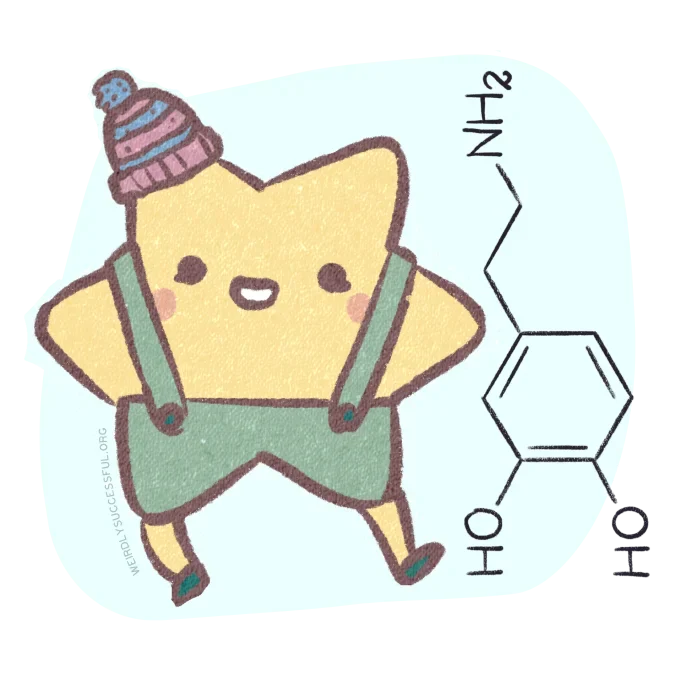
Dopamine
Group: Neurotransmitter (catecholamine family)
Produced in: Ventral tegmental area (VTA), substantia nigra, hypothalamus (A11 nucleus), and — surprisingly — the gut. Most dopamine neurons live in the midbrain, but their axons reach across the brain through distinct pathways.
Built from: Tyrosine (amino acid from dietary protein) → converted by tyrosine hydroxylase (requires iron) → L-DOPA → dopamine
Also known as: The salience chemical. Often incorrectly called the “feel-good” or “reward” chemical.
Role: Motivation, attention, executive function, movement, emotional regulation, pain modulation, learning, and memory. Helps the brain decide what matters right now and how much to respond to it.
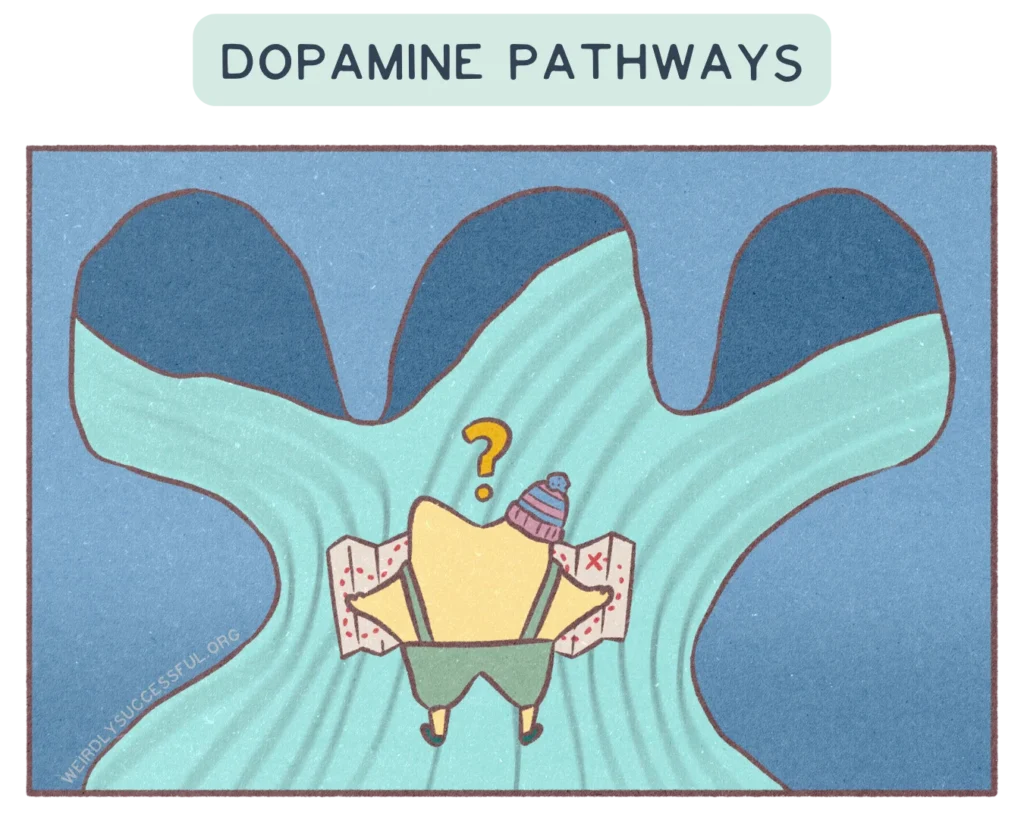
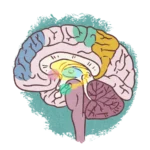
Main pathways:
- Mesolimbic — reward and motivation
- Mesocortical — executive function and attention
- Nigrostriatal — movement and action selection
- A11-spinal — descending pain modulation
Close relatives: Norepinephrine (synthesised from dopamine — they’re literally family)
Likes: Tyrosine, iron, adequate sleep, aerobic exercise, novel and interesting tasks, being left in the synapse long enough to do its job
Dislikes: Being called a “feel-good chemical,” iron deficiency, being cleared from the synapse too quickly, boring repetitive tasks with no intrinsic reward, being “detoxed,” and supplement companies speaking on its behalf
Conditions involving dopamine differences: ADHD, Parkinson’s disease, restless leg syndrome, Tourette syndrome, fibromyalgia, schizophrenia, bipolar disorder
Commonly confused with: Serotonin (different chemical, different jobs, different pathways — though they interact). Also confused with pleasure, when it’s actually more about wanting than liking.
Movement
Dopamine in the nigrostriatal pathway — running from the substantia nigra to the dorsal striatum — regulates movement and action selection. This is the pathway most affected in Parkinson’s disease, where dopamine-producing neurons die, and movement becomes increasingly difficult.
In ADHD, differences in this pathway show up as hyperactivity, restlessness, fidgeting, and sometimes as difficulties with fine motor control — clumsiness, struggling with handwriting, and bumping into things.5 None of these happens because you are careless and aloof; your dopaminergic signalling in motor circuits is just working on different settings.
Emotional regulation
Dopamine doesn’t just affect what you do. It affects what you feel and how quickly you feel it. Emotional dysregulation — reacting more intensely than a situation seems to warrant, having difficulty calming down after an emotional response, experiencing mood shifts that feel disproportionate — affects roughly 30–70% of adults with ADHD.8
This can feel like having a short fuse and getting upset in situations that seem neutral to other people. It can also feel like the other end: when you’ve been upset by something, it’s harder to calm down, to let it go, to decompress. You might feel shaken for hours after an argument that someone else has already forgotten. The emotional volume knob doesn’t work smoothly — it jumps between settings rather than sliding gradually.
This is partly about dopamine’s role in the prefrontal cortex (regulating emotional responses) and partly about its role in the reward pathway (calibrating how much emotional weight to give different experiences).9
Pain modulation
When it comes to dopamine, the fact that it also modulates pain is barely mentioned, even though this fact alone torpedoes the “reward chemical” naming.
Your brain has a dedicated system for turning the volume down on pain signals as they travel up the spinal cord. The A11 nucleus in the hypothalamus sends dopaminergic projections down to the spinal cord, where D2 receptors at pain-processing synapses actively dampen incoming pain signals.11 This is a descending inhibitory pathway — your brain uses dopamine to decide how much attention a pain signal deserves before it reaches conscious awareness.
In ADHD, this system is calibrated differently. Lab studies show that unmedicated adults with ADHD have lower cold pain thresholds and tolerance than controls 12, and children with ADHD show lower pressure pain thresholds.13 But it’s not uniformly “more sensitive” — some people with ADHD report reduced pain awareness, not noticing injuries or illness until they’re severe. The pattern is unreliable calibration rather than simply more or less sensitive. Sounds familiar? It’s the courier again. Sometimes the pain signal arrives too loud, sometimes it doesn’t arrive at all, and you can’t predict which one is about to happen.
Stimulant medication affects this directly. Methylphenidate raises pain thresholds toward normal levels in both adults and children with ADHD.1213 Case reports describe dramatic improvement of chronic pain after starting stimulant medication, maintained over years.17 The mechanism is the same one that helps with attention: more dopamine available in the circuits that need it, meaning the brain’s own volume control works more effectively — whether the signal it’s calibrating is a boring task, an emotional reaction, or a pain message from your lower back.
A chemical involved in pain modulation, movement, motivation, attention, emotional regulation, and learning is not a “feel-good” chemical. Calling it a salience chemical would be more accurate.
Learning and memory
Dopamine is involved in how the brain encodes new information and retrieves existing memories, particularly through its action in the prefrontal cortex (working memory) and the hippocampus (long-term memory formation).10 Working memory — which has the ability to hold and manipulate information over short periods — is critical for following multi-step instructions, maintaining a train of thought, and keeping track of what you were about to do before you got distracted.
If you’ve ever walked into a room and forgotten why, re-read the same paragraph three times, or lost the thing you were holding thirty seconds ago, this is the system involved.
What conditions are connected to dopaminergic neurotransmission problems?
Dopamine systems have a central role in conditions like ADHD, Tourette syndrome, bipolar disorder, schizophrenia, and Parkinson’s disease.
Dopamine plays a role in pain processing, and abnormalities with the dopamine system are present in fibromyalgia and restless leg syndrome.
Ageing brains also have changed dopamine levels, which can be responsible for many neurological symptoms in old age.
What dopamine doesn’t do
It’s not a “feel-good” chemical
This is the most common misconception, and this naming can lead to a lot of bad advice. Dopamine is frequently described as the chemical that makes you feel pleasure. The research, however, confirms dopamine is more closely associated with wanting rather than with liking.4 It drives the motivation to pursue something, but it has no involvement in the enjoyment of having it. The pleasure you feel when eating chocolate or hearing a song you love involves the opioid system more than the dopamine system. Dopamine is what made you want the chocolate in the first place, what made you open the streaming app to find the song. So dopamine is responsible for anticipation and drive, not satisfaction.
The “feel-good” framing leads to advice like “do things that give you dopamine hits.” This implies that dopamine is a reward you collect by doing pleasurable things, and that you can run low on it by doing too many pleasurable things (hence the “dopamine detox” concept). Neither is how the system works.
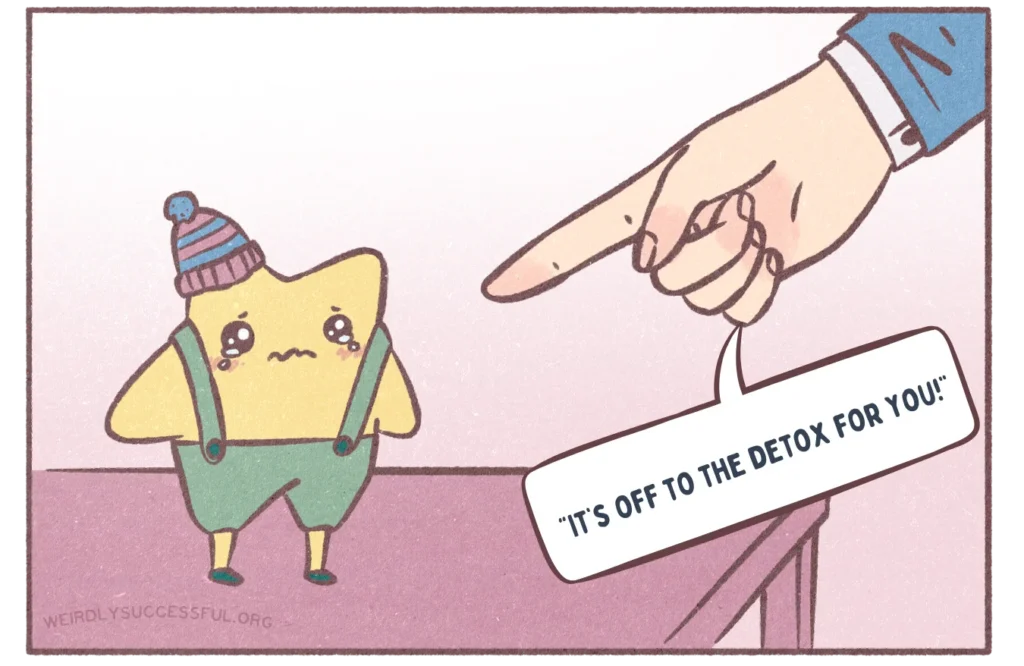
“Dopamine detox” is not a real thing
When we do something that feels good, like eating a delicious meal or receiving a compliment, our brain releases dopamine, which can reinforce that behaviour and make us more likely to repeat it in the future. This is a good thing; when our system does this, it is working as intended. Dopamine detoxes are unnecessary and harmful.
The idea behind a dopamine detox is that modern life (social media, junk food, constant stimulation) floods your brain with dopamine, depleting or desensitising your receptors, and that abstaining from stimulation for a period allows the system to reset.
The neuroscience doesn’t support this. Dopamine is continuously manufactured and regulated by the brain through feedback loops. You cannot “deplete” it through normal activity, and receptor sensitivity adjusts in response to sustained pharmacological intervention (like medication), not from scrolling your phone too much. The concept confuses habituation (the psychological experience of needing more stimulation to feel engaged) with neurochemical depletion (a physiological state). They are not the same thing.
Can reducing screen time and overstimulation improve how you feel? Probably. Is that a dopamine detox? No. It’s a behavioural change with behavioural effects. Calling it a detox imports a neurochemical explanation that the behaviour doesn’t support, and it feeds the misconception that dopamine is a finite resource you can run out of.
Science note: There are situations where dopamine receptor downregulation occurs — chronic use of certain drugs (cocaine, methamphetamine) produces measurable changes in D2 receptor density. But this is a pharmacological effect of sustained, high-dose receptor stimulation, not something that happens from enjoying your life too much. Equating recreational drug neuroadaptation with checking Instagram is not scientifically valid, and the comparison trivialises actual substance use disorders.
Why rewards and punishments don’t work the way people think
If you’ve ever been told to “reward yourself with a treat after doing a task” and found that it did absolutely nothing, the dopamine system is why.
The advice assumes a typically functioning reward pathway: the brain anticipates the reward, generates dopamine-driven motivation, and that motivation sustains effort through the boring middle of the task. In ADHD, the reward pathway’s response to anticipated future rewards is blunted.12 Knowing there might be a nice thing at the end doesn’t produce more dopamine. All it gets is a shrug from your brain.
On the other hand, punishment also doesn’t work — because if it did, people with ADHD wouldn’t struggle with late fees and fines stacking up. Threatening someone with a bad outcome doesn’t generate the dopamine needed to initiate and sustain the task. In most cases, people with ADHD are acutely aware of both the bad outcomes and the good ones. They have preferential outcomes; they know what they want, and executive dysfunction still doesn’t let them start or finish the task at hand.
Rewards and punishment can work short-term — you can muster up some urgency and force yourself to do the thing, but it is unsustainable as a long-term coping mechanism. After a while, it can lead to resentment, burnout or just stop working in the first place.
Executive dysfunction is not a lack of willpower, and therefore, it cannot be motivated with rewards or punishments. Understanding this — really understanding it, not just intellectually agreeing with it — is one of the most important things dopamine science has to offer. And this takeaway can be yours right now, no need to buy any supplement or do any elaborate morning routine hack. Neuroscience directly contradicts everything that made you believe you are lazy, careless, worthless, or morally failing because you can’t make yourself “do the thing.” With ADHD, the system that translates the thought (“I want to“) into action (“I am doing“) is tuned differently, and no amount of willpower, punishment or bribery can sustainably change this. It is not your personal failure if you couldn’t lifehack your brain into submission.
Dopamine and medication
ADHD medications work by changing how dopamine and norepinephrine behave in the brain. They don’t add dopamine from outside (like, for example, insulin medication would add more insulin to the system). Stimulant medications change what happens to the dopamine your brain already makes.
Methylphenidate (Ritalin, Concerta) blocks dopamine transporters, slowing reuptake — the process that pulls dopamine back out of the synapse after release. The dopamine stays active longer, giving receptors more time to respond. PET imaging shows that the degree of dopamine increase in the ventral striatum predicted how much inattention improved over 12 months of treatment.3
Lisdexamfetamine (Vyvanse, Elvanse) acts at multiple points: it increases dopamine release, blocks reuptake, and inhibits breakdown. This is why it can help people for whom methylphenidate alone isn’t enough — it’s intervening at more stages of the system.
Atomoxetine (Strattera) is a norepinephrine reuptake inhibitor rather than a dopamine one. It works on the norepinephrine system, which indirectly increases dopamine availability in the prefrontal cortex. This is covered in more detail in our norepinephrine entry.
For a full breakdown of the seven stages of the dopamine production chain and where each medication acts, see our dopamine system entry.
You probably know this already, but we will keep mentioning it every time it comes up. Taking properly prescribed, properly titrated stimulant medication is not recreational drug use. It is not the same as using illegal substances, and the fact that it helps you function is not addiction. Stimulant medication at therapeutic doses normalises dopamine signalling in circuits that are running below their optimal range. Whereas recreational stimulant use floods the system far beyond the normal range, which is a completely different pharmacological event with completely different consequences.
Dopamine and self-medication
Before diagnosis, before medication, before any understanding of what dopamine is or does, many neurodivergent people were already trying to regulate their dopamine system intuitively. This includes a heavy caffeine habit or regular consumption of alcohol, which was the only thing that switched the brain off. For some people, it also includes risky behaviours that produced the adrenaline spike that finally made things feel enough.
Several of these patterns can cause real harm: excessive caffeine can produce anxiety, insomnia, and caffeine use disorder rather than the focus it promises.24 Alcohol feels calming initially, but worsens executive function over time. Recreational drugs like cocaine directly block dopamine reuptake — the same mechanism as methylphenidate, but at wildly higher, uncontrolled doses — producing an intense high followed by a crash that leaves the system worse off than before.
Research supports the self-medication hypothesis: people with unrecognised ADHD and autism use specific substances to manage specific states, not for the reasons commonly assumed.2223 Understanding why these patterns make neurochemical sense is part of understanding yourself. It doesn’t make them safe, but it removes the moral framing that turns a neurological pattern into a personal failing.
For more on how everyday substances interact with the brain — including caffeine, alcohol, and lemon balm — see the blood-brain barrier section of our brain entry.
How to evaluate a dopamine claim
You now know enough to test any dopamine claim you encounter. Here’s your checklist:
Is it treating dopamine as if it only does one thing? Dopamine is involved in motivation, attention, movement, emotional regulation, pain processing, and learning. Any claim that reduces it to “the reward chemical” or “the feel-good molecule” has already oversimplified enough to be unreliable. A person telling you how to “boost your dopamine” without specifying which pathway, which stage of the chain, or which function they’re targeting is selling a feeling, not a mechanism.
Which stage of the system is it targeting? The dopamine system has multiple stages: raw material supply, manufacturing, storage, release, reception, reuptake, and breakdown. A supplement providing raw materials (like L-tyrosine) is doing something completely different from a medication that slows reuptake (like methylphenidate). If a product or practice doesn’t tell you which stage it acts on, it probably doesn’t know — or doesn’t want you to.
What’s the evidence, and who’s presenting it? Individual testimonials are not clinical evidence. A study on mice is not the same as a study on humans. A study on healthy adults under acute stress is not the same as a study on adults with ADHD. And if the article recommending the product is published on the same website that sells the product, the recommendation and the revenue are not independent of each other.
Does it acknowledge individual variation? Any claim that implies the same intervention works for everyone with ADHD ignores what the research actually shows: ADHD involves different dopamine differences in different circuits in different people.4 What helps depends on where the bottleneck is, and that’s an individual question. Blanket claims are a red flag.
Does it promise to replace medical support? Supplements, lifestyle changes, and behavioural strategies can all support the dopamine system. Some of them address real deficiencies that make symptoms worse. But they act at different stages of the system, from medication, and for many people, the bottleneck is at a stage that nutritional support cannot reach. Anything that tells you to choose between a supplement and your medication — rather than discussing them as potentially complementary — has an agenda that isn’t your wellbeing.
« Back to the index




 emotional dysregulation