

• Skip to main content
  • Skip to header right navigation
  • Skip to site footer
Weirdly Successful

Weirdly Successful

Dedicated to helping you understand, navigate and enjoy your weird & wonderful neurodivergent life.

  • About Us
    • The team
    • The mission
    • What we do
    • Events
  • Learn
    • Understanding Neurodivergence
    • Diagnosis & Assessment
    • Productivity & Planning
    • Sensory & Body
    • Emotions & Regulation
    • Health & Wellbeing
    • Work & Career
  • Free Resources
    • Latest Articles
    • Neurodivergent Glossary
    • Resource Library
  • Contact Us
    • Send a message
    • Book a Curiosity Call

“Does ADHD mean you’re always hyperactive?”

energy focus movement speech
by
Adam Dobay (author)  
Livia Farkas (additional content)  

First published: 4 February, 2026 | Last edited: 4 February, 2026 || 📚🕒 Reading Time: 2 minutes

No.

One aspect of ADHD is difficulties in the brain’s impulse self-regulation systems, which in childhood can manifest as movement that’s deemed excessive—but this is neither required for ADHD nor the whole story of what hyperactivity means.

ADHD has different presentations: predominantly inattentive, predominantly hyperactive-impulsive, and combined. In fact, 93% of adults with ADHD have either the predominantly inattentive or combined presentations, and the inattentive type is paradoxically under-recognised despite its high prevalence. 1

ADHD is more than attention — or hyperactivity

The stereotypical image of an ADHD person (usually a child) is someone who

  • Is impulsive (climbs trees! Runs into traffic in the street! Whacks others with stones in the head!)
  • Distractable (proverbial squirrel moments! Starts to do a bunch of things simultaneously!)
  • Dazed and confused (can’t pay attention to anything! Doesn’t put in the effort! Forgets everything! Especially the important stuff!)

The stereotypes range from Manic Pixie Dream Girl or Rowdy Little Boy cuteness to Mad Scientist aggravating to Absolute Basket Case.
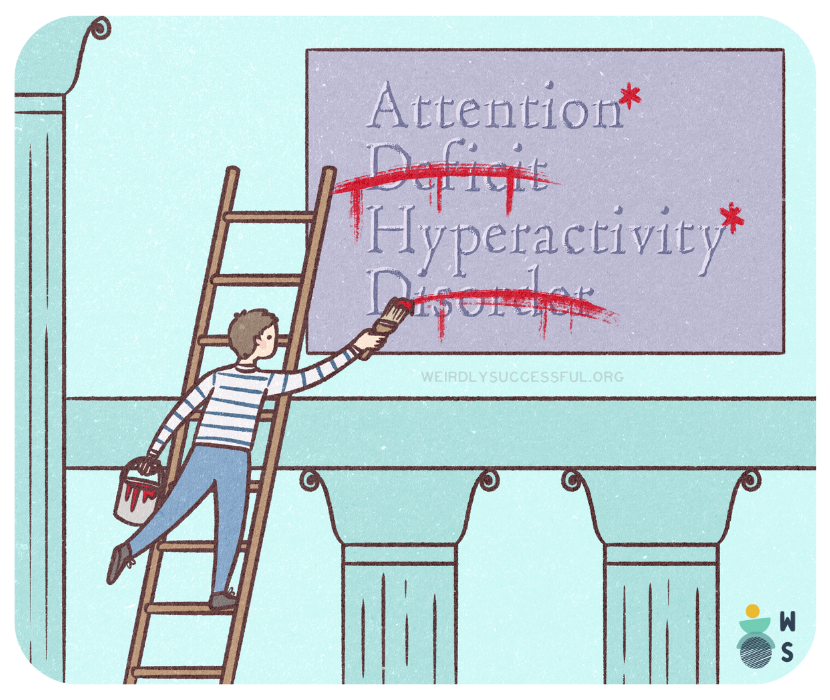
ADHD is not just about attention or hyperactivity, and it’s neither a deficit nor a disorder, but otherwise the name is perfect. /s

The problem is, this is a very narrow focus on something vastly complex.

Here’s where the terminology causes real problems: many people with ADHD are afraid to try stimulant medication because they think, “I don’t need to be more stimulated, my sleep is already disturbed, thank you very much!”

But the word “stimulant” describes the medication’s mechanism, not its effect on someone with ADHD. These medications work by increasing dopamine and norepinephrine levels in the brain, which improves attention, executive function, and self-regulation.2 Low doses actually help people feel calmer and more focused, not more “hyper.” Some even benefit from a small dose before bed for more restful sleep.

Hyperactivity can be invisible

Hyperactivity tends to become less overt with age, turning into inner restlessness, difficulty relaxing, talkativeness, or constant mental activity in teens and adults.3 Many people with ADHDers calm on the outside while experiencing racing thoughts or internal restlessness. The problem is that our language creates a reality: if you don’t match the stereotype the name suggests, you might not recognise your own ADHD or be taken seriously when seeking a diagnosis.

« Back to the index


References
1↑ de la Peña, I. C., Pan, M. C., Thai, C. G., & Alisso, T. (2020). Attention-Deficit/Hyperactivity Disorder Predominantly Inattentive Subtype/Presentation: Research Progress and Translational Studies. Brain sciences, 10(5), 292.
2↑ Arnsten, A. Stimulants: Therapeutic Actions in ADHD. Neuropsychopharmacol 31, 2376–2383 (2006).
3↑ Biederman, J., Mick, E., & Faraone, S. V. (2000). Age-dependent decline of symptoms of attention deficit hyperactivity disorder: impact of remission definition and symptom type. The American journal of psychiatry, 157(5), 816–818.

Related Questions

1
"Is ADHD just about not being able to pay attention?"
emotions memory regulation time
Explore answer
2
I have tried traditional "self-care" activities, and they don't do anything for me. What am I doing wrong?
coping strategies self-care sensory support
Explore answer
3
What's actually happening when I go into verbal shutdown?
communication language stress
Explore answer

Related Terms

auditory stimming

Auditory stimming is a natural self-regulatory behavior that involves making sounds with your voice, either through non-word vocalizations (vocal stimming) or speech-based expressions (verbal stimming). This form of stimming helps with emotional regulation, sensory processing, and achieving comfort and focus.

Learn more
communication sensory voice
inertia

Inertia is the experience of being unable to start (or stop) an activity despite wanting to. It's a common neurodivergent experience related to executive function, and not caused by laziness, procrastination or lack of motivation. Like a car without fuel, no amount of pressing the gas pedal will help when the resources needed for action aren't available.

Learn more
motivation
context switching

Context switching refers to the cognitive process of shifting attention between different tasks or mental states. It involves disengaging from one task and engaging in another, requiring the brain to change its focus, rules, and objectives. This process can be mentally taxing due to the cognitive load involved in stopping one task and starting another, shifting gears to focus on the new task, and getting accustomed to the new situation with all its stimuli. Frequent context switching and jumping from task to task can lead to a decrease in productivity and efficiency.

Learn more
memory
demand avoidance

Demand avoidance means appearing opposed to doing something when it's perceived as a demand, especially from an authority figure - even if you actually want to do the thing. While it may look like defiance or stubbornness to others, it's actually an involuntary self-preservation response triggered by threats to autonomy. This response happens automatically, not as a conscious decision to be difficult.

Learn more
communication motivation
autistic burnout

Autistic burnout refers to a state of physical, mental, and emotional exhaustion experienced by autistic people. It is a result of prolonged exposure to overwhelming sensory, social, and cognitive demands, often in an environment that does not accommodate their needs.

Learn more
motivation pain
decision fatigue

Decision fatigue refers to the deteriorating quality of decision-making after a long period of decision-making activity. It means you feel mentally exhausted from making too many choices.

Learn more
motivation
Previous Post:“Is ADHD just about not being able to pay attention?”

About the Authors

  • Adam Dobay

    Adam Dobay is a Neurodivergent Training Developer, Co-Founder of Weirdly Successful, and Co-Chair of the Lived Experience Advisory Panel (LEAP) for NHS Sussex's All-Age Neurodevelopmental Programme, contributing to pathway development, training design, and service improvement across Sussex. With 2,400+ hours developing neurodivergent-focused training materials and 500+ hours of direct client support, he brings both professional rigour and personal understanding of late-identified neurodivergence to his work.

    View all posts
  • Livia Farkas

    Livia Farkas is an adult education specialist with a joy-centred approach and a sharp sense for simplifying complex ideas using silly visual metaphors.

    Since 2008, she's written 870+ articles, developed 294 distinct techniques, and co-created 8 online courses with Adam—with 5,302 alumni learning neurodivergent-friendly approaches to time management, goal setting, self-care, and small business management.

    Her life goal is to be a walking permission slip for neurodivergent adults.

    View all posts

Free Resources for Neurodivergent Adults

Get our research-backed, experience-validated strategies & guides for a neurodivergent work & life that you can adapt to what success looks like to you.

Create a free account to get your goodies!

Is the button not working? No worries!
Sometimes ad-blocks stop all pop-ups, even if they are not ads.
This might be the case if nothing happens when you click the button.
Here’s another, non-pop-up way to sign up, please try if this works!

By signing up you allow us to send you Weirdly Successful’s newsletter with practical tips, strategies, and optional training material.
You can unsubscribe any time. Our Privacy Policy makes for a great summer reading!

Weirdly Successful is a 100% neurodivergent-run non-profit, developing strategies & frameworks for neurodivergent adults.

  • E-mail
  • Instagram
  • Mastodon
  • Tumblr
  • Pinterest

DISCLAIMER: All content on this website is for informational purposes only, and does not substitute for medical advice. For medical advice, diagnosis or treatment, consult a medical professional or healthcare provider.

While we strive to represent up-to-date and scientifically accurate information, our authors are not medical professionals unless where specifically noted. All opinions are the authors’ own.

Weirdly Successful’s authors and collaborators are not liable for risks or issues
associated with using or acting upon the information on our site.

All original content Copyright © 2026 · Weirdly Successful · All Rights Reserved.

Privacy Policy