
• Skip to main content
  • Skip to header right navigation
  • Skip to site footer
Weirdly Successful

Weirdly Successful

Dedicated to helping you understand, navigate and enjoy your weird & wonderful neurodivergent life.

  • About Us
    • The team
    • The mission
    • What we do
    • Events
  • Learn
    • Understanding Neurodivergence
    • Diagnosis & Assessment
    • Productivity & Planning
    • Sensory & Body
    • Emotions & Regulation
    • Health & Wellbeing
    • Work & Career
  • Free Resources
    • Latest Articles
    • Neurodivergent Glossary
      • My Glossary
    • Questions & Answers
    • Resource Library
  • Contact Us
    • Send a message
    • Book a Curiosity Call
  • LOGIN

deep pressure

self-care self-regulation sensory support touch
by
Livia Farkas (author)  

First published: 11 November, 2023 | Last edited: 30 April, 2026 |🕒 Reading Time: 2 minutes | 🔗
Login / Register to save article for later

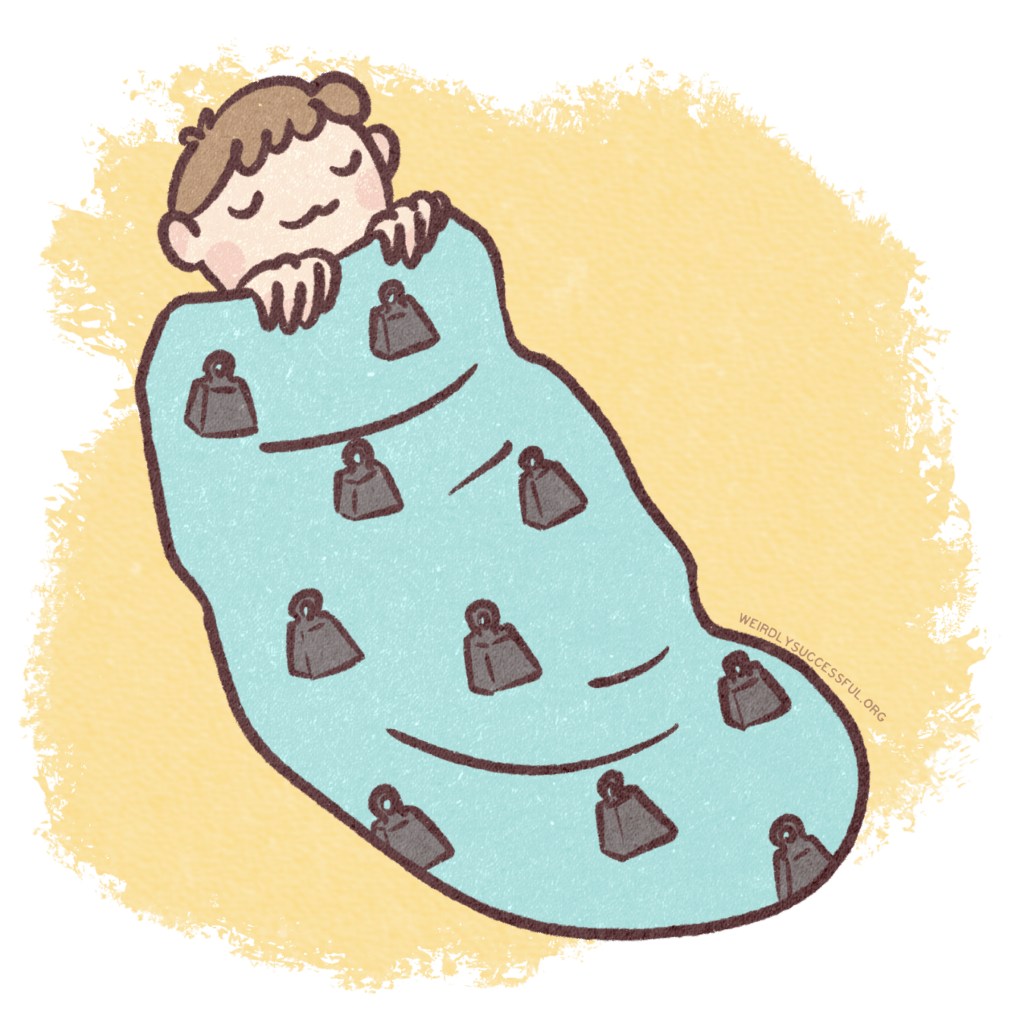
Deep pressure is a natural sensory need where firm, consistent pressure (like heavy blankets or tight hugs) helps tension melt away from your body. Many people naturally seek this through things like snug clothing or curling up under blankets – it’s your nervous system’s way of finding calm and comfort.

Deep pressure is particularly beneficial for people with sensory processing issues.

Who is deep pressure for?

You may already be engaging in activities that provide deep pressure without realising it. 🙂 While deep pressure can be part of occupational therapy, it doesn’t need a therapeutic setting to work.

You can try it at home by using a weighted blanket, or ask to be wrapped up in a nice bear hug from someone you love. It also works with massages and activities that naturally provide deep pressure, such as swimming or yoga, where the water pressure or body positions exert a calming, grounding effect.

These natural behaviours can be comforting and grounding, helping you feel more centred.

Seeking deep pressure — through weighted blankets, tight clothing, firm hugs, or compression — is a sensory-seeking form of restricted repetitive behaviour that helps regulate the nervous system, and for many neurodivergent adults it becomes a reliable go-to precisely because the body learns to depend on that specific input.

What does deep pressure feel like?

Deep pressure is often described as a comforting, grounding sensation. It can feel like a warm hug or a gentle weight that envelops the body, providing a sense of safety and calm. This experience can be particularly soothing during times of stress or sensory overload.

How does it work?

Many neurodivergent individuals seek deep pressure as a way to self-soothe and manage anxiety. It can serve as a coping mechanism to help regulate emotions and create a sense of stability in overwhelming situations.

This form of tactile sensory input can stimulate the parasympathetic nervous system, reducing anxiety and promoting feelings of calm and relaxation. It can also improve body awareness, focus, and overall sensory integration.

Using deep pressure in stressful situations measurably lowers the heart rate, as it was found in a study of autistic students. 1
Why deep pressure calms the nervous system

Deep pressure activates mechanoreceptors in muscle and connective tissue rather than the surface-level receptors that handle light or sudden touch 2. These deep-tissue receptors send signals through the somatosensory cortex, mid insula, and supramarginal gyrus — a pathway that overlaps with but is distinct from gentle social touch. The effect on the autonomic nervous system is consistent across studies: heart rate decreases, sympathetic arousal drops, and parasympathetic activity increases 314. This is why deep pressure reliably produces a feeling of calm rather than a feeling of being trapped — it’s processed through a sensory channel that’s wired toward settling the body down.

Is deep pressure the same as restriction?

While deep pressure is something you choose and control for comfort, restriction is very different – it’s when someone or something limits your movement against your wishes.

Deep pressure should always feel releasing and calming, never constraining or distressing. You should be able to easily adjust or stop the pressure whenever you want.

Restriction feels threatening and distressing, like being trapped against your will. This distinction is crucial because some people mistakenly try to force deep pressure on others, which turns a potentially comforting experience into harmful restriction.

« Back to the index

References
1↑ Afif, I., Manik, A., Munthe, K., Maula, M., Ammarullah, M., Jamari, J., & Winarni, T. (2022). Physiological Effect of Deep Pressure in Reducing Anxiety of Children with ASD during Traveling: A Public Transportation Setting. Bioengineering, 9.
2↑ Case, L., Liljencrantz, J., McCall, M., Bradson, M., Necaise, A., Tubbs, J., Olausson, H., Wang, B., & Bushnell, M. (2020). Pleasant deep pressure: Expanding the social touch hypothesis. Neuroscience, 464, 3–11.
3↑ Chen, H., Yang, H., Men, C., Shen, C., & Chen, H. (2025). Effect of deep pressure input on autonomic regulation during wisdom tooth extraction: From waiting room to surgery. Journal of Dental Sciences, 20, 1204–1212.
4↑ Reynolds, S., Lane, S., & Mullen, B. (2015). Effects of deep pressure stimulation on physiological arousal. American Journal of Occupational Therapy, 69(3), 6903350010p1–5.

Related Questions

“I have tried traditional “self-care” activities, and they don’t do anything for me. What am I doing wrong?”

coping strategies energy
Explore answer

“Why do I like pressure on my body?”

Explore answer

“Why do I watch the same show over and over?”

coping strategies energy
Explore answer


Related Terms

decompressing

Decompressing refers to engaging in activities or behaviours that allow a person to relax, unwind, and alleviate stress or sensory overload. This term is particularly significant in the neurodivergent community as we often experience heightened sensitivity to environmental stimuli, leading to increased stress and anxiety levels. Making sure to have time to decompress after especially taxing events is an essential part of self-care.

Learn more

stimming

Stimming (self-stimulatory behaviour) tends to be more intense, deliberate, and repetitive. It can include hand flapping, rocking, making repetitive sounds, spinning, examining textures intensely, or listening to the same song on repeat for hours. Stimming is historically associated with autism and serves primarily as emotional and sensory regulation—a way to manage overwhelming feelings, process sensory input, express joy or excitement, or meet a physiological need for specific sensory feedback. Autistic people often describe stimming as a need rather than a choice.

eating focus movement sound vision
Learn more

sensory avoiding

Sensory avoiding, also known as sensory under-responsivity, refers to a pattern of behaviour where individuals actively try to avoid or minimise exposure to sensory stimuli. These individuals may have a heightened sensitivity to sensory input and...

eating pain sound
Learn more

sensory seeking

Sensory-seeking refers to a behavioural pattern or tendency in neurodivergent folks where they actively seek out and engage in sensory experiences or stimuli. People may have a heightened desire for sensory input and actively seek activities or environments that provide intense or stimulating sensations.

eating hearing movement
Learn more

Related Articles

How To Make Your Life Neurodivergent-friendly

You've tried all the ADHD tips online, but nothing seems to stick. That's because neurodivergent brains don't come with universal solutions—what helps one person might not work for you at all. Here's how to discover your specific adaptations and create a life that actually works for YOUR brain. Explore your needs, what environments you work best in, what overwhelms you, and what helps you regulate.

communication
Read article

I Wasn’t ‘Just A Bit Stressed Out’

Exploring the impact of internalised ableism made me re-evaluate my misinterpreted autistic and ADHD traits.

society
Read article

Previous Post:ARFID
Next Post:double empathy

About the Author

  • Livia Farkas

    Livia Farkas is an adult education specialist with a joy-centred approach and a sharp sense for simplifying complex ideas using silly visual metaphors.

    Since 2008, she's written 870+ articles, developed 294 distinct techniques, and co-created 8 online courses with Adam—with 5,302 alumni learning neurodivergent-friendly approaches to time management, goal setting, self-care, and small business management.

    Her life goal is to be a walking permission slip for neurodivergent adults.

    View all posts

Free Resources for Neurodivergent Adults

Get our research-backed, experience-validated strategies & guides for a neurodivergent work & life that you can adapt to what success looks like to you.

Create a free account to get your goodies!

Is the button not working? No worries!
Sometimes ad-blocks stop all pop-ups, even if they are not ads.
This might be the case if nothing happens when you click the button.
Here’s another, non-pop-up way to sign up, please try if this works!

By signing up you allow us to send you Weirdly Successful’s newsletter with practical tips, strategies, and optional training material.
You can unsubscribe any time. Our Privacy Policy makes for a great summer reading!

Weirdly Successful is a 100% neurodivergent-run non-profit, developing strategies & frameworks for neurodivergent adults.

  • E-mail
  • Instagram
  • Mastodon
  • Tumblr
  • Pinterest

DISCLAIMER: All content on this website is for informational purposes only, and does not substitute for medical advice. For medical advice, diagnosis or treatment, consult a medical professional or healthcare provider.

While we strive to represent up-to-date and scientifically accurate information, our authors are not medical professionals unless where specifically noted. All opinions are the authors’ own.

Weirdly Successful’s authors and collaborators are not liable for risks or issues
associated with using or acting upon the information on our site.

All original content Copyright © 2026 · Weirdly Successful · All Rights Reserved.

Privacy Policy