
• Skip to main content
  • Skip to header right navigation
  • Skip to site footer
Weirdly Successful

Weirdly Successful

Dedicated to helping you understand, navigate and enjoy your weird & wonderful neurodivergent life.

  • About Us
    • The team
    • The mission
    • What we do
    • Events
  • Learn
    • Understanding Neurodivergence
    • Diagnosis & Assessment
    • Productivity & Planning
    • Sensory & Body
    • Emotions & Regulation
    • Health & Wellbeing
    • Work & Career
  • Free Resources
    • Latest Articles
    • Neurodivergent Glossary
      • My Glossary
    • Questions & Answers
    • Resource Library
  • Contact Us
    • Send a message
    • Book a Curiosity Call
  • LOGIN

“Does caffeine help with ADHD?”

coping strategies energy focus food medication
by
Livia Farkas (author)  

First published: 6 August, 2026 | Last edited: 6 August, 2026 |🕒 Reading Time: 2 minutes | 🔗
Login / Register to save article for later

Yes, and no.

If you’ve ever felt like coffee is the only thing standing between you and a completely non-functional morning, research in neurochemistry backs you up. But it doesn’t mean you get a permission slip to drink all the coffee you want, because it comes with a few caveats.

How does caffeine help with focus & regulation?

Caffeine blocks adenosine receptors in the brain, and one of the downstream effects is a modest increase in dopamine availability in the prefrontal and striatal circuits most affected in ADHD.1 It acts on the same systems that prescribed stimulants target, which is why it can feel less like a preference and more like a necessity.

But while it may feel like it helps, research found that it works less and less as you consume more.

Caffeine works for the short term, loses efficacy long-term

A 2023 meta-analysis of randomised trials found no significant improvement in ADHD symptoms with caffeine compared to placebo2, and caffeine was consistently outperformed by methylphenidate and amphetamines on every measure tested.34

And a large cross-sectional study of over 2,000 adults found no association between caffeine consumption and ADHD symptom severity5, and no controlled clinical trials exist for adults with ADHD.3

Caffeine also builds tolerance quickly. With regular use, the adenosine system adapts, and the same cup of coffee that used to sharpen your focus starts merely preventing withdrawal grogginess.6 Many regular caffeine users are topping up to baseline rather than gaining a boost above it, and the cycle of caffeine use, disrupted sleep, and next-day fatigue can end up compounding the attention problems it was supposed to help with.7

Still, reaching for caffeine to regulate an ADHD brain has a neurochemical logic behind it, even if caffeine, as it turns out, doesn’t do the job well enough to rely on long-term.

Explore this topic

  • For more on why neurodivergent adults reach for specific substances and what the evidence says about supported alternatives, see the self-medication entry.
  • And if you want to know how dopamine works in the ADHD brain, read our entry on the dopamine system.

« Back to the index
References
1↑ Pandolfo, P. et al. (2013). Caffeine regulates frontocorticostriatal dopamine transporter density and improves attention and cognitive deficits in an animal model of ADHD. European Neuropsychopharmacology, 23, 317–328.
2↑ Perrotte, G. et al. (2023). Effects of caffeine on main symptoms in children with ADHD: a systematic review and meta-analysis of randomized trials. Brain Sciences, 13.
3↑ Ioannidis, K., Chamberlain, S. & Müller, U. (2014). Ostracising caffeine from the pharmacological arsenal for attention-deficit hyperactivity disorder — was this a correct decision? A literature review. Journal of Psychopharmacology, 28, 830–836.
4↑ Leon, R.M. (2000). Effects of caffeine on cognitive, psychomotor, and affective performance of children with attention-deficit/hyperactivity disorder. Journal of Attention Disorders, 4, 27–47.
5↑ Ágoston, C. et al. (2022). Self-medication of ADHD symptoms: does caffeine have a role? Frontiers in Psychiatry, 13.
6↑ Reichert, C., Deboer, T. & Landolt, H. (2022). Adenosine, caffeine, and sleep–wake regulation: state of the science and perspectives. Journal of Sleep Research, 31.
7↑ Gardiner, C. et al. (2023). The effect of caffeine on subsequent sleep: a systematic review and meta-analysis. Sleep Medicine Reviews, 69, 101764.

Related Questions

“Why does coffee make me sleepy when I have ADHD?”

Does coffee calm you down instead of waking you up? ADHD brains can respond to stimulants by settling down.

sleep
Explore answer

“Can supplements help with ADHD?”

Yes, and no. Whether supplements can help with your ADHD depends on where the support need is for you when it comes to your dopamine system.

neurobiology support
Explore answer

“Why do I do better with a routine?”

Because routine is architecture you can rely on when everything else is wobbly or up in the air. When you do the same things in the same order, your brain doesn't have to build the day from scratch. The route is known, the sequence is mapped, all the decisions have already been made, and you are good to go. This frees up precious cognitive resources for the things that actually need your attention.

motivation self-regulation support
Explore answer

Related Glossary Terms

self-medication

Self-medication means using substances — consciously or not — to regulate brain states. Many unidentified or late-identified neurodivergent adults reach for caffeine, alcohol, or nicotine because these act on the same neurochemistry that works differently in their brains.

support
Learn more

The neurodivergent brain

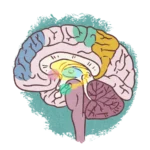
The brain is the organ behind every neurodivergent trait you experience — from how you pay attention to how you process emotion to how you sleep. Neurodivergent brains use the same basic structures and chemical messengers as any brain, but the tuning is different: different dopamine activity in reward circuits, different balance between excitatory and inhibitory signalling, different default mode network behaviour.

anxiety emotions memory motivation neurobiology self-regulation sleep
Learn more

rigid thinking (cognitive inflexibility)

Cognitive inflexibility, also erroneously referred to as rigid thinking, is a diagnostic characteristic of autism that describes difficulty shifting between tasks, perspectives, or plans. The label captures how the trait looks from outside — but the internal experience is better understood through monotropism: a processing style that goes deep rather than wide. The depth that makes sustained focus, thoroughness, and reliability possible is the same depth that makes switching costly. The difficulty and the strength are the same mechanism.

communication emotions motivation thoughts
Learn more

synaptic pruning

Synaptic pruning is the process by which the brain refines its connections during development, removing synapses that are used less frequently while strengthening active ones. In autistic brains, this process works differently — two independent cleanup systems (the neuron's internal recycling programme and the brain's specialised immune cells) are both less aggressive, meaning significantly more connections are retained. This denser wiring contributes to many recognisable autistic experiences: sensory intensity, deep focus, rich pattern recognition, difficulty filtering, and the challenge of switching between tasks or environments.

neurobiology pain self-regulation sensory
Learn more

Related Articles

Make Your Life Neurodivergent-friendly with the Adaptation Explorer Workbook

Neurodivergent brains don't come with universal solutions—what helps one person might not work for you at all. So if you've tried all the ADHD tips online, but nothing seems to stick, you're not alone. Here's how to discover your specific adaptations and create a life that actually works for YOUR brain. Explore your needs, what environments you work best in, what overwhelms you, and what helps you regulate.

communication self-care support
Read article

Why self-compassion is more important than self-care

Self-compassion literally means what it says on the tin: you have compassion for yourself. You can feel empathy towards yourself, you can be kind, even loving towards yourself. But it is often overlooked in favour of self-care. Learn why it's so crucial for every neurodivergent person to learn self-compassion.

self-care self-image
Read article

Previous Post:neuroplasticity
Next Post:“Why does coffee make me sleepy when I have ADHD?”

About the Author

  • Livia Farkas

    Livia Farkas is an adult education specialist with a joy-centred approach and a sharp sense for simplifying complex ideas using silly visual metaphors.
    Since 2008, she's written 870+ articles, developed 294 distinct techniques, and co-created 8 online courses with Adam—with 5,302 alumni learning neurodivergent-friendly approaches to time management, goal setting, self-care, and small business management.
    Her life goal is to be a walking permission slip for neurodivergent adults.

    View all posts

Free Resources for Neurodivergent Adults

Get our research-backed, experience-validated strategies & guides for a neurodivergent work & life that you can adapt to what success looks like to you.

Create a free account to get your goodies!

Is the button not working? No worries!
Sometimes ad-blocks stop all pop-ups, even if they are not ads.
This might be the case if nothing happens when you click the button.
Here’s another, non-pop-up way to sign up, please try if this works!

By signing up you allow us to send you Weirdly Successful’s newsletter with practical tips, strategies, and optional training material.
You can unsubscribe any time. Our Privacy Policy makes for a great summer reading!

Weirdly Successful is a 100% neurodivergent-run non-profit, developing strategies & frameworks for neurodivergent adults.

  • E-mail
  • Instagram
  • Mastodon
  • Tumblr
  • Pinterest

DISCLAIMER: All content on this website is for informational purposes only, and does not substitute for medical advice. For medical advice, diagnosis or treatment, consult a medical professional or healthcare provider.

While we strive to represent up-to-date and scientifically accurate information, our authors are not medical professionals unless where specifically noted. All opinions are the authors’ own.

Weirdly Successful’s authors and collaborators are not liable for risks or issues
associated with using or acting upon the information on our site.

All original content Copyright © 2026 · Weirdly Successful · All Rights Reserved.

Privacy Policy