
• Skip to main content
  • Skip to header right navigation
  • Skip to site footer
Weirdly Successful

Weirdly Successful

Dedicated to helping you understand, navigate and enjoy your weird & wonderful neurodivergent life.

  • About Us
    • The team
    • The mission
    • What we do
    • Events
  • Learn
    • Understanding Neurodivergence
    • Diagnosis & Assessment
    • Productivity & Planning
    • Sensory & Body
    • Emotions & Regulation
    • Health & Wellbeing
    • Work & Career
  • Free Resources
    • Latest Articles
    • Neurodivergent Glossary
    • Questions & Answers
    • Resource Library
  • Contact Us
    • Send a message
    • Book a Curiosity Call

decision fatigue

energy focus motivation
by
Livia Farkas (author)  

First published: 30 June, 2023 | Last edited: 28 March, 2026 || 📚🕒 Reading Time: 2 minutes ||

What is decision fatigue?

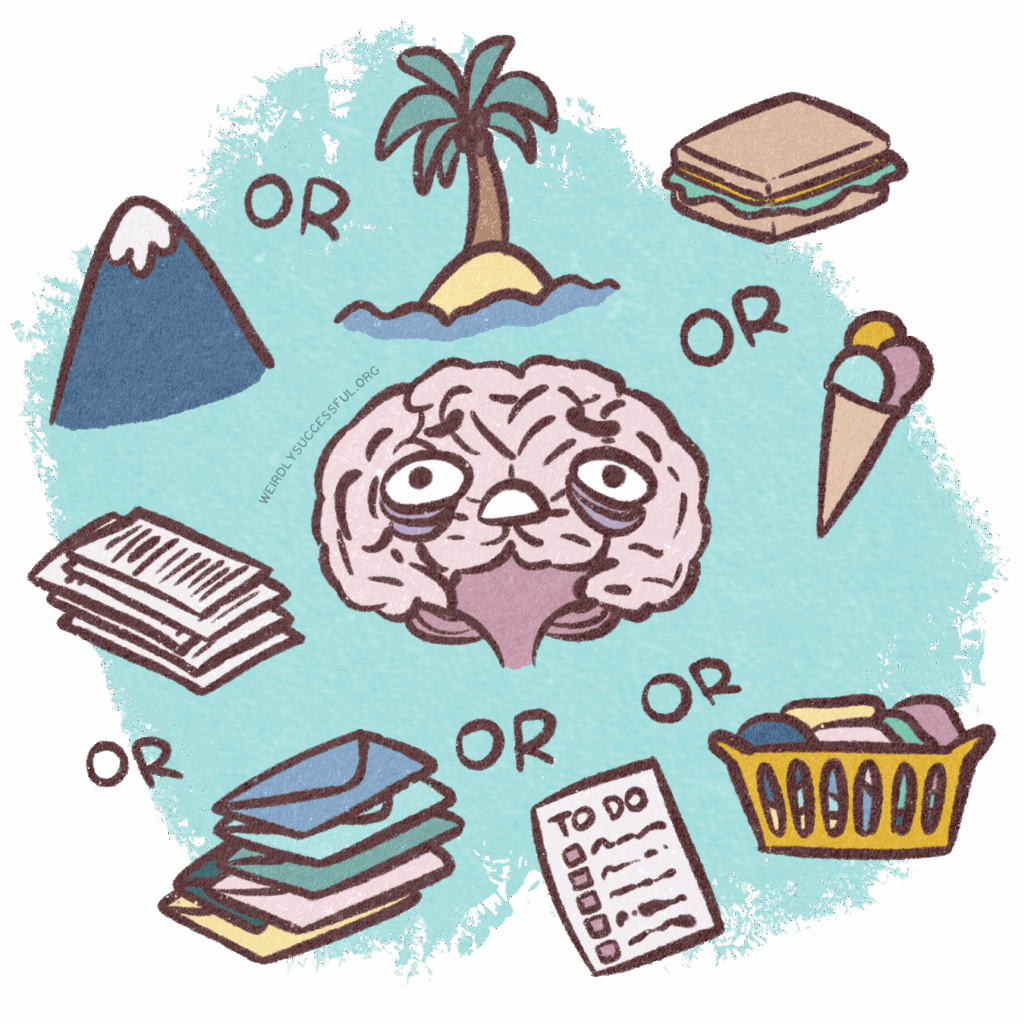
Decision fatigue refers to the deteriorating quality of decision-making after a long period of decision-making activity. It means you feel mentally exhausted from making too many choices.

When you’ve been picking between different options for a while, eventually, your brain gets tired and starts to make not-so-great decisions. The more choices you have to make, the worse your decision-making skills become.

How does decision fatigue affect everyday life?

Naturally, having difficulty making good decisions or making decisions at all can affect all sorts of things in life.

For example, a study found that when people get worn out from making choices, they start to lose self-control and make poor decisions in areas like health and money.1

Another study even showed that decision fatigue can make some people more likely to act unethically. 2

Decision-making and neurodivergence

ADHDers may exhibit reduced decision-making abilities and higher levels of decision fatigue compared to individuals without ADHD, and it can even show up in everyday situations when the choices to make are not life-altering. What you eat, wear, and which train to take to work – these are all tiny choices and making them adds up.

Researchers3 found that specific executive functions, such as working memory and inhibitory control, played a crucial role in explaining the relationship between ADHD symptoms and decision-making difficulties.

Autistic individuals also have to mitigate decision-making difficulties.4

Every decision involves some degree of unknown outcome, which is why intolerance of uncertainty and decision fatigue tend to amplify each other — each choice carries more cognitive and emotional weight when the consequences feel genuinely unpredictable rather than just unresolved.
How to prevent decision fatigue

It’s really important to find ways to give your brain a break.

You can reduce the number of decisions you have to make by creating flexible routines that support you, adjustments that guide you without having to think of them, and automated processes that make it easier for you to go through the day.

Related Questions

"Why do I do better with a routine?"

self-regulation support
Explore answer

"Why do people fidget when they are hyperactive?"

movement self-regulation
Explore answer

"Does ADHD mean you're always hyperactive?"

diagnosis movement speech
Explore answer

What's the difference between being 'lazy' and experiencing executive dysfunction?

Explore answer

"Why do I watch the same show over and over?"

coping strategies self-care self-regulation sensory
Explore answer

"Is fidgeting and stimming the same thing?"

movement self-regulation
Explore answer

"Don't people grow out of ADHD?"

coping strategies diagnosis identity society support
Explore answer

"Is ADHD just about not being able to pay attention?"

emotions memory self-regulation time
Explore answer

"I have tried traditional "self-care" activities, and they don't do anything for me. What am I doing wrong?"

coping strategies self-care self-regulation sensory support
Explore answer

"Why do traditional productivity methods make me feel worse instead of better?"

coping strategies productivity
Explore answer
« Back to the index
References
1↑ Muraven, M., Baumeister, R. F., & Tice, D. M. (1998). Ego depletion: A resource model of volition, self-regulation, and controlled processing. Social Cognition, 18(2), 130-150. | Source
2↑ Vohs, K. D., Baumeister, R. F., Schmeichel, B. J., Twenge, J. M., Nelson, N. M., & Tice, D. M. (2008). Making choices impairs subsequent self-control: A limited-resource account of decision-making, self-regulation, and active initiative. Journal of Personality and Social Psychology, 94(5), 883-898. https://psycnet.apa.org/doiLanding?doi=10.1037%2F0022-3514.94.5.883
3↑ Empirical examination of executive functioning, ADHD associated behaviors, and functional impairments in adults with persistent ADHD, remittent ADHD, and without ADHD https://www.ncbi.nlm.nih.gov/pmc/articles/PMC7092442/
4↑ Decision-making difficulties experienced by adults with autism spectrum conditions https://journals.sagepub.com/doi/10.1177/1362361311415876

Related Terms

rigid thinking (cognitive inflexibility)

Cognitive inflexibility, also erroneously referred to as rigid thinking, is a diagnostic characteristic of autism that describes difficulty shifting between tasks, perspectives, or plans. The label captures how the trait looks from outside — but the internal experience is better understood through monotropism: a processing style that goes deep rather than wide. The depth that makes sustained focus, thoroughness, and reliability possible is the same depth that makes switching costly. The difficulty and the strength are the same mechanism.

Learn more
communication emotions thoughts
inertia

Inertia is the experience of being unable to start (or stop) an activity despite wanting to. It's a common neurodivergent experience related to executive function, and not caused by laziness, procrastination or lack of motivation. Like a car without fuel, no amount of pressing the gas pedal will help when the resources needed for action aren't available.

Learn more
demand avoidance

Demand avoidance means appearing opposed to doing something when it's perceived as a demand, especially from an authority figure - even if you actually want to do the thing. While it may look like defiance or stubbornness to others, it's actually an involuntary self-preservation response triggered by threats to autonomy. This response happens automatically, not as a conscious decision to be difficult.

Learn more
communication stress
autistic burnout

Autistic burnout refers to a state of physical, mental, and emotional exhaustion experienced by autistic people. It is a result of prolonged exposure to overwhelming sensory, social, and cognitive demands, often in an environment that does not accommodate their needs.

Learn more
pain
inattentive

Inattentive is one of the ADHD subtypes, also known as the distracted type. Inattentive traits include daydreaming, forgetfulness (not remembering the question while answering, forgetting things at home, following instructions with multiple sub-tasks), and difficulty focusing on a task that’s not engaging enough.

Learn more
memory
executive dysfunction

Executive functions are essential, they help us make plans, stay organized, pay attention, and keep our emotions in check. It plays a big role in making decisions and adapting to new situations. Executive dysfunction can happen when these processes have a difference or impairment that affects everyday life.

Learn more
memory time
Previous Post:SSRIs
Next Post:misophonia

About the Author

  • Livia Farkas

    Livia Farkas is an adult education specialist with a joy-centred approach and a sharp sense for simplifying complex ideas using silly visual metaphors.

    Since 2008, she's written 870+ articles, developed 294 distinct techniques, and co-created 8 online courses with Adam—with 5,302 alumni learning neurodivergent-friendly approaches to time management, goal setting, self-care, and small business management.

    Her life goal is to be a walking permission slip for neurodivergent adults.

    View all posts

Free Resources for Neurodivergent Adults

Get our research-backed, experience-validated strategies & guides for a neurodivergent work & life that you can adapt to what success looks like to you.

Create a free account to get your goodies!

Is the button not working? No worries!
Sometimes ad-blocks stop all pop-ups, even if they are not ads.
This might be the case if nothing happens when you click the button.
Here’s another, non-pop-up way to sign up, please try if this works!

By signing up you allow us to send you Weirdly Successful’s newsletter with practical tips, strategies, and optional training material.
You can unsubscribe any time. Our Privacy Policy makes for a great summer reading!

Weirdly Successful is a 100% neurodivergent-run non-profit, developing strategies & frameworks for neurodivergent adults.

  • E-mail
  • Instagram
  • Mastodon
  • Tumblr
  • Pinterest

DISCLAIMER: All content on this website is for informational purposes only, and does not substitute for medical advice. For medical advice, diagnosis or treatment, consult a medical professional or healthcare provider.

While we strive to represent up-to-date and scientifically accurate information, our authors are not medical professionals unless where specifically noted. All opinions are the authors’ own.

Weirdly Successful’s authors and collaborators are not liable for risks or issues
associated with using or acting upon the information on our site.

All original content Copyright © 2026 · Weirdly Successful · All Rights Reserved.

Privacy Policy