





• Skip to main content
  • Skip to header right navigation
  • Skip to site footer
Weirdly Successful

Weirdly Successful

Dedicated to helping you understand, navigate and enjoy your weird & wonderful neurodivergent life.

  • About Us
    • The team
    • The mission
    • What we do
    • Events
  • Latest Articles
  • Free Resources
    • Neurodivergent Glossary
    • Resource Library
  • Contact Us
    • Send a message
    • Book a Curiosity Call

I have tried traditional “self-care” activities, and they don’t do anything for me. What am I doing wrong?

coping strategies energy self-care sensory support
by
Adam Dobay (author)  
Nora Selmeczi (co-author) ,  
Livia Farkas (co-author)  
Juli Martos (illustrator)  

First published: 3 November, 2025 | Last edited: 7 January, 2026 || 📚🕒 Reading Time: 2 minutes

Nothing! Neurodivergent brains need more time to process, decompress, and recharge.

It probably has to do with how

  • our brains have to process a lot more stimuli from the environment (sights, sounds, smells, information, etc.)
  • our nervous system is way more interconnected
  • some brain areas might not be able to communicate as well with each other.

For us neurodivergent folks, the type of rest has to match our needs.

A lot of neurotypical forms of rest work against what we need.

“Candle-lit bubble bath?” If you’re ADHD, an understimulating environment might force your brain to keep up your basic dopamine functioning… by cranking up the volume on internal monologues and earworms!

“Treat yourself, go out, have fun!” If you’re already overstimulated, even more noises and sights and sounds and people means you’ll need even more decompression afterwards.

“Cook something nice?” If your executive functioning system is all spent for the day, your brain will have to work even harder to remember the steps and manage everything.

“Just drop everything?” If you’re hyperfocusing on something, the sudden switch alone can be literally painful.

For neurodivergent folks, neurotypical rest is just another task.

Try one of these instead, and see how they work for you!

  • If you feel out of your body, do gentle movement with focused breathing, like yoga or pilates.
  • If you’re overstimulated, maybe you need complete darkness and quiet.
  • If you spend all day masking (because you have to in order to survive), block time in your calendar when you can simply be in your safe space and let your brain be led by whatever interest comes up and wander or hyperfocus.
  • If you’re in your head, you might need to crank up the intensity. So stim, dance, spin, roll, sing, make noise, run, jump, lift weights, do breathwork. Get in your body, feel alive!
  • If you’re understimulated and need a sense of control, find an immersive activity to get lost in. Pick up a video game or an audiobook with a nice voice and let yourself be guided. Anything involving more than one sense.
  • If you feel all over the place or out of control, and you have a creative or ‘maker’ type hobby, go do that. (As long as it doesn’t feel like work!)
  • Oh, and however you choose to rest & decompress, don’t forget to eat. And drink water. We tend to forget that. The body needs energy!

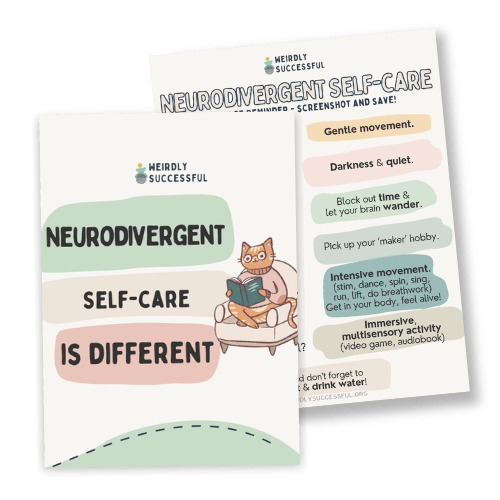
Download this as a printable PDF!

Grab this guide as a printable PDF with a handy one-pager to screenshot as save as a reminder.

Download now from The Library, our free resource hub.
Go to the Library
« Back to the index

Related Questions

1
Why get a diagnosis just to get a label?
diagnosis identity self-confidence
Explore answer
2
What can a neurodivergent diagnosis give me if I got this far on my own?
adhd autism diagnosis
Explore answer
3
Why do traditional productivity methods make me feel worse instead of better?
focus productivity
Explore answer

Related Terms

decompressing

Decompressing refers to engaging in activities or behaviours that allow a person to relax, unwind, and alleviate stress or sensory overload. This term is particularly significant in the neurodivergent community as we often experience heightened sensitivity to environmental stimuli, leading to increased stress and anxiety levels. Making sure to have time to decompress after especially taxing events is an essential part of self-care.

Learn more
regulation
deep pressure

Deep pressure is a natural sensory need where firm, consistent pressure (like heavy blankets or tight hugs) helps tension melt away from your body. Many people naturally seek this through things like snug clothing or curling up under blankets - it's your nervous system's way of finding calm and comfort.

Learn more
regulation touch
night terrors

Night terrors are episodes of intense fear during sleep that involve screaming, physical movement, and autonomic arousal (racing heart, rapid breathing, sweating). Unlike nightmares, they occur during non-REM sleep with no memory of the event afterwards. Night terrors affect both children and adults, with higher prevalence in neurodivergent populations, particularly those with ADHD. They're triggered by sleep disruption, stress, hormonal changes, and sometimes medication, reflecting both neurological and environmental factors.

Learn more
periods sleep
transitions

Transitioning, in the context of neurodiversity, refers to the process of moving from one state, activity, or place to another. It involves a shift in attention, focus, and cognitive resources. For neurodivergent individuals, it may require additional time, support, and strategies to manage effectively. Transitioning can encompass a wide range of changes, from minor daily shifts like moving from one task to another, to major life changes such as transitioning from school to work or from living at home to independent living.

Learn more
unmasking

Unmasking is when you slowly learn to allow your neurodivergence to present itself and you don't try to hide yourself. However, to unmask is a privilege, as you need a safe space to do it.

Learn more
relationships society
stimming

Stimming (also known as self-stimulating) is a common sensory-seeking neurodivergent behaviour. It means stimulating yourself in a repetitive manner to self-soothe, regulate, or express excitement. Stimming is common both in ADHD and autism. Stimming movements, however, are common in all human beings. Everybody stims, whether it's chewing the end of a pencil while you think, swaying back and forth to the rhythm of the music while you're standing in line, or swinging your legs when they can't touch the ground.

Learn more
eating focus movement regulation sound touch vision
Previous Post:How can I recognize when I’m about to make an impulsive decision?
Next Post:I’m afraid of a ‘diagnosis’, I don’t want to be ‘fixed’!

About the Authors

  • Adam Dobay

    Adam Dobay is a Neurodivergent Training Developer applying 18 years of practical knowledge gained in constructing engaging online education frameworks as well as using storytelling for personal development and mental health goals.
    An award-winning copywriter, screenwriter and independent researcher, Adam holds certifications in ADHD coaching and understanding Autism, and with co-founder and wife Livia, has spent over 2400 hours developing training materials for people with neurodivergent traits.

    View all posts
  • Nora Selmeczi

    Nora Selmeczi is an experienced Project Specialist with a penchant for crafting accessible workflows and unearthing relevant structural insights. They build on 15 years of experience in organisations from NGOs to global corporations like IBM, OMD, and We Are Social. Their processes to reliably attain specific business goals have become best practices in 50+ markets.
    As workshop facilitator and project coordinator, Nora has designed & facilitated over 90 ideation workshops, delivered Train The Trainer sessions, writer’s workshops and editorial workflows. At Weirdly Successful they distil their skills and professional experience into inclusive insight work and customised workshop offerings.

    View all posts
  • Livia Farkas

    Livia is a Neurodivergent Adaptation Educator with a sharp sense for simplifying complex ideas. Since 2008, she's developed 294 distinct techniques catered to the needs of clients. A total of 5058 alumni have enrolled in one or more of the 8 online courses she co-developed with Adam, offering neurodivergence-inclusive frameworks for time management, goal setting, self-care for mental health, and small-business management.
    Her life goal is to be a walking permission slip for neurodivergent adults.
    In her free time, she enjoys stickers & planners, crochet & roller skates, and running around with her pet bunny Rumi.

    View all posts
  • Juli Martos

    Weirdly Successful's resident artist is Juli Martos, a psychologist by trade, and illustrator by practice.
    Juli lives in Budapest, Hungary with her rescue kittens and partner, and loves to play video games in her spare time.

    View all posts

Free Resources for Neurodivergent Adults

Get our research-backed, experience-validated strategies & guides for a neurodivergent work & life that you can adapt to what success looks like to you.

Create a free account to get your goodies!

Is the button not working? No worries!
Sometimes ad-blocks stop all pop-ups, even if they are not ads.
This might be the case if nothing happens when you click the button.
Here’s another, non-pop-up way to sign up, please try if this works!

By signing up you allow us to send you Weirdly Successful’s newsletter with practical tips, strategies, and optional training material.
You can unsubscribe any time. Our Privacy Policy makes for a great summer reading!

Weirdly Successful is a 100% neurodivergent-run non-profit, developing strategies & frameworks for neurodivergent adults.

  • E-mail
  • Instagram
  • Mastodon
  • Tumblr
  • Pinterest

DISCLAIMER: All content on this website is for informational purposes only, and does not substitute for medical advice. For medical advice, diagnosis or treatment, consult a medical professional or healthcare provider.

While we strive to represent up-to-date and scientifically accurate information, our authors are not medical professionals unless where specifically noted. All opinions are the authors’ own.

Weirdly Successful’s authors and collaborators are not liable for risks or issues
associated with using or acting upon the information on our site.

All original content Copyright © 2026 · Weirdly Successful · All Rights Reserved.

Privacy Policy
