
• Skip to main content
  • Skip to header right navigation
  • Skip to site footer
Weirdly Successful

Weirdly Successful

Dedicated to helping you understand, navigate and enjoy your weird & wonderful neurodivergent life.

  • About Us
    • The team
    • The mission
    • What we do
    • Events
  • Learn
    • Understanding Neurodivergence
    • Diagnosis & Assessment
    • Productivity & Planning
    • Sensory & Body
    • Emotions & Regulation
    • Health & Wellbeing
    • Work & Career
  • Free Resources
    • Latest Articles
    • Neurodivergent Glossary
      • My Glossary
    • Questions & Answers
    • Resource Library
  • Contact Us
    • Send a message
    • Book a Curiosity Call
  • LOGIN

penguin pebbling

interests relationships
by
Livia Farkas (author)  

First published: 12 November, 2023 | Last edited: 12 January, 2026 |🕒 Reading Time: < 1 minute | 🔗
Login / Register to save article for later

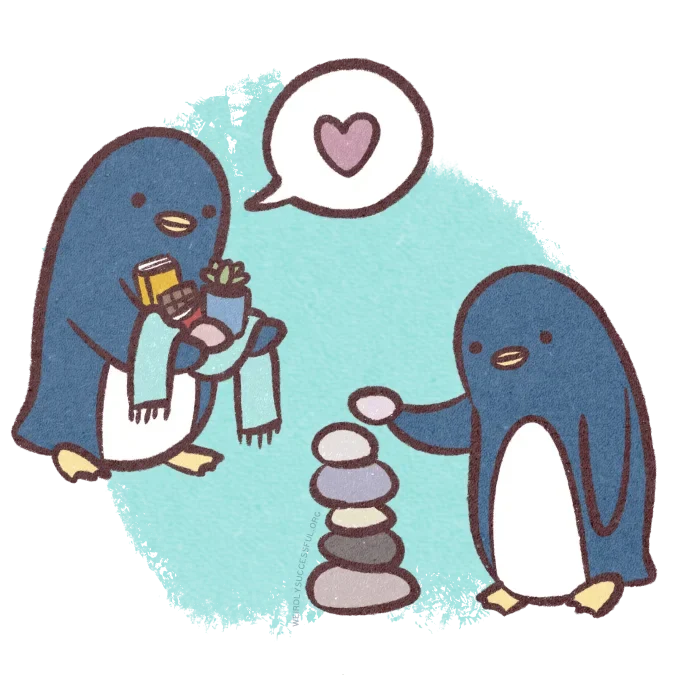
Penguin pebbling is a term derived from the behaviour of Adélie penguins who meticulously collect and arrange pebbles to build their nests.

In a neurodivergent context, the expression is used to describe a common neurodivergent behaviour of people collecting and giving loved items to others – “this made me think of you, I think you’ll like this, I thought this was pretty and I want you to have it“.

While the “pebbles” can be physical items, they could also include memes, funny videos, and even info dumping.
« Back to the index


Related Glossary Terms

info dumping

Info dumping is the casual name referring to the act of sharing an extensive amount of information, usually about a subject or topic the person is extremely passionate about.

communication
Learn more

special interests

Special interests are deeply focused areas of engagement that autistic people experience with a level of emotional investment, sustained attention, and joy that goes well beyond typical hobbies. Clinically categorised under restricted repetitive behaviours, special interests are one of the defining characteristics of autism — and for most autistic adults, they are a primary source of motivation, regulation, identity, and connection. Between 75% and 95% of autistic people have at least one special interest, and 82% have more than one.

communication joy self-regulation sensory
Learn more

Rejection Sensitivity Dysphoria (RSD)

Rejection Sensitivity Dysphoria (RSD) is an intense emotional and physical response to perceived rejection, criticism, or the fear of falling short — experienced by many neurodivergent people. The hot flash of shame, the spiral of "what did I do wrong," the doomsday scenarios building while the other person is simply answering their front door — these are recognisable experiences for many people who grew up having their authentic selves ignored, dismissed, or misunderstood. RSD is a pattern recognition system shaped by real history, and having language for it means you can begin to watch the reaction rather than be yanked along by it.

communication pain self-regulation stress
Learn more

object constancy

Object constancy is the notion that you remain connected and aware of items or people even when they are not visible or physically around. Difficulties in object constancy lead to the "out of sight, out of mind" experience, which is very common with ADHD folk. Not to be confused with object permanence, which is a developmental stage in babies, and relates to them believing things genuinely stop existing when not in sight.

communication focus memory
Learn more

Related Articles

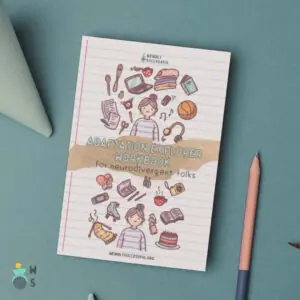
Make Your Life Neurodivergent-friendly with the Adaptation Explorer Workbook

Neurodivergent brains don't come with universal solutions—what helps one person might not work for you at all. So if you've tried all the ADHD tips online, but nothing seems to stick, you're not alone. Here's how to discover your specific adaptations and create a life that actually works for YOUR brain. Explore your needs, what environments you work best in, what overwhelms you, and what helps you regulate.

communication self-care support
Read article

Previous Post:info dumping
Next Post:ADHD tax

About the Author

  • Livia Farkas

    Livia Farkas is an adult education specialist with a joy-centred approach and a sharp sense for simplifying complex ideas using silly visual metaphors.
    Since 2008, she's written 870+ articles, developed 294 distinct techniques, and co-created 8 online courses with Adam—with 5,302 alumni learning neurodivergent-friendly approaches to time management, goal setting, self-care, and small business management.
    Her life goal is to be a walking permission slip for neurodivergent adults.

    View all posts

Free Resources for Neurodivergent Adults

Get our research-backed, experience-validated strategies & guides for a neurodivergent work & life that you can adapt to what success looks like to you.

Create a free account to get your goodies!

Is the button not working? No worries!
Sometimes ad-blocks stop all pop-ups, even if they are not ads.
This might be the case if nothing happens when you click the button.
Here’s another, non-pop-up way to sign up, please try if this works!

By signing up you allow us to send you Weirdly Successful’s newsletter with practical tips, strategies, and optional training material.
You can unsubscribe any time. Our Privacy Policy makes for a great summer reading!

Weirdly Successful is a 100% neurodivergent-run non-profit, developing strategies & frameworks for neurodivergent adults.

  • E-mail
  • Instagram
  • Mastodon
  • Tumblr
  • Pinterest

DISCLAIMER: All content on this website is for informational purposes only, and does not substitute for medical advice. For medical advice, diagnosis or treatment, consult a medical professional or healthcare provider.

While we strive to represent up-to-date and scientifically accurate information, our authors are not medical professionals unless where specifically noted. All opinions are the authors’ own.

Weirdly Successful’s authors and collaborators are not liable for risks or issues
associated with using or acting upon the information on our site.

All original content Copyright © 2026 · Weirdly Successful · All Rights Reserved.

Privacy Policy