


Nope. Not everyone is a little bit ADHD. Saying everyone’s a little bit ADHD is a nice attempt at inclusion at best, and a dismissal of ADHD lived experience at worst. But the reason why “everyone’s a bit ADHD” is best avoided as a generalisation is that the statement carries a fundamental misunderstanding of what ADHD is, and how it works.
Let’s break it down.
Experience: yes. Frequency & intensity: no.
ADHD traits are human traits.
By this we mean that many of the experiences of ADHD people are things that neurotypical people also experience. Everybody can recall a time in their life where they felt a bit scattered, got lost in thought, left their phone at home, acted based on an impulse, got irritated while waiting in a queue, or forgot what they went into the room for. Sleep deprivation, stress, grief, being overworked — these things do that to any brain.
These alone aren’t neurodivergent-specific experiences. They’re “having a brain and being a human” experiences.
The actual difference is that ADHD people don’t have some of these experiences every once in a while. They have many of them a lot: multiple times a day, an hour, every time in a given context. What makes these traits neurodivergent is not that they exist, it’s the frequency of experiences and the intensity with which they affect someone’s life every single day.
Is everyone a bit neurodivergent, though?
While we’re here, let’s tackle a very similar other statement that’s been going around. That one goes something like “okay, not everyone’s ADHD, but everyone’s a bit neurodivergent“.
The assumption here is that neurodivergence is some sort of scale, with “a bit” neurodivergent people on one and, and “a lot” neurodivergent on another.
Again, bonus points for trying to be inclusive, but the difference between neurotypical and neurodivergent people is fundamental. Here’s a better way to visualise it:
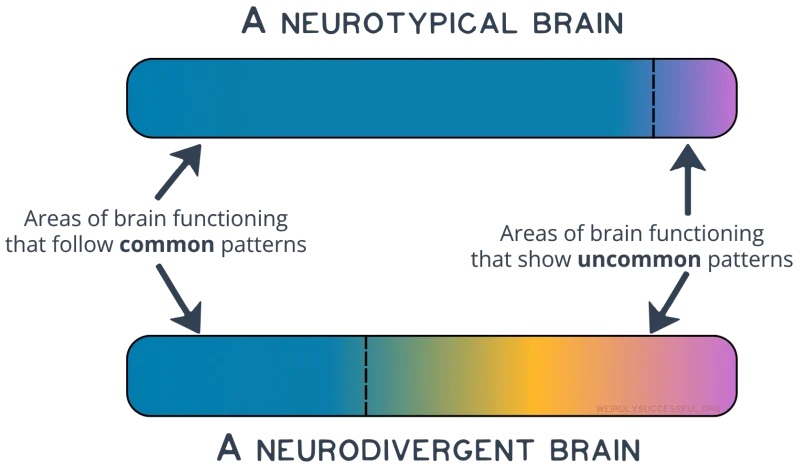
If a brain is neurotypical, it’s not on the left side of “the neurodivergence scale”, it’s not even on the same scale.
The main reason it’s called “neurotypical” is because most of the ways that the brain functions follow common patterns. There are variations . Neurodivergent brains are neurodivergent because how they work diverges from what would be typical in a significant amount of brain areas.
(And to allow a moment of linguistic pedantry, everyone can’t be divergent because then what would they be diverging from?)
The scale thing doesn’t really work anyway, as every single person will have a unique combination of traits and how those traits show up in their life.
You can also think of it like hair. Most people have hair: long, short, different colours, textures, curl patterns. Some people have their hair colour in common but not its length. But if we’re talking about curls and dry hair, a bald man cannot say “yeah, I am also on the hair spectrum.” 😀
The bottom line: neurodiversity is the term that includes both neurotypical and neurodivergent people. Neurodivergence only includes neurodivergent people, and not every human is neurodivergent. If we were, neurodivergent people wouldn’t still have to fight for basic understanding and support.
(And while we’re at it, don’t forget that one person on their own can’t be neurodiverse. Because grammar.)
So no, we’re not all “on the spectrum”. Forgetting something a few times is not “so ADHD of me”, organising the cupboard isn’t “so OCD” and being surprised by not being bored at the train museum isn’t “so autistic.”
The clinical threshold for an ADHD diagnosis is not “do you have some of these traits?” but “do these traits impair your functioning across multiple areas of your life?” When someone says “everyone has a little ADHD”, this difference is completely disregarded.
For more on how ADHD works, see all our ADHD articles here.
« Back to the index




 “Is ADHD just a lack of willpower?”