• Skip to main content
  • Skip to header right navigation
  • Skip to site footer
Weirdly Successful

Weirdly Successful

Dedicated to helping you understand, navigate and enjoy your weird & wonderful neurodivergent life.

  • About Us
    • The team
    • The mission
    • What we do
    • Events
  • Learn
    • Understanding Neurodivergence
    • Diagnosis & Assessment
    • Productivity & Planning
    • Sensory & Body
    • Emotions & Regulation
    • Health & Wellbeing
    • Work & Career
  • Free Resources
    • Latest Articles
    • Neurodivergent Glossary
      • My Glossary
    • Questions & Answers
    • Resource Library
  • Contact Us
    • Send a message
    • Book a Curiosity Call
  • LOGIN

neuroaffirming

society support
by
Weirdly Successful
Weirdly Successful (author)  

First published: 28 June, 2023 | Last edited: 22 January, 2026 |🕒 Reading Time: 2 minutes | 🔗
Login / Register to save article for later

What does neuroaffirming mean?

Neuroaffirming or neuro-affirmative refers to practices, approaches, or environments that recognize and affirm the neurodiversity of society and the neurodivergence of individuals.

An environment is neuroaffirming if it is designed to honour and celebrate the diverse ways in which brains are wired.

An approach cannot be neuroaffirming if it uses stigmatizing, moralizing, ableist or deficit-based language.

Stigmatizing language: uses negative labels, stereotypes, slurs to describe someone with a neurodivergent conditon.

Moralizing language: when one’s needs are judged as being personal failings, e.g. laziness, or proof of poor character.

Ableist language: any language that uses the baseline that humans with differences are less-than, and deems inclusion efforts as a waste of resources or unnecessary.

Deficit-based language: describes neurodivergent conditions based on what the individual lacks, e.g. “lacks normal social skills” or “attention deficit”. (Unfortunately, in many cases, the condition names themselves – like ADHD or ASD – contain D as in deficit/disorder.)

What is the difference between awareness and acceptance?

Awareness is not enough. Affirming neurodivergence means creating space for, valuing and empowering neurodivergent individuals, not just simply being aware that we exist.

What does a neuroaffirming approach look like in practice?

Neuroaffirming practices aim to create inclusive and supportive spaces where individuals with different neurological profiles are valued, respected, and understood.

This involves challenging societal norms or stigmas associated with neurodivergent conditions and promoting acceptance and accommodation instead.

Neuroaffirming has a dual approach of empowerment and support:

  • One focus is on empowering individuals to embrace and showcase their strengths and talents,
  • while also providing necessary support and accommodations to help navigate any challenges they may face.

Creating a neuroaffirming society cannot happen without listening to the neurodivergent community and asking what they need.

Neuroaffirming practices could include:

  • creating accessible learning environments
  • adjusting communication styles
  • providing sensory-friendly spaces,
  • and promoting inclusive policies and practices in various settings such as schools, workplaces, and communities.

What is the goal of neurodivergent acceptance?

Through neuroaffirming practices, the goal is to fight ableism and to foster a more inclusive and accepting society that recognizes the inherent value and contributions of all individuals, regardless of their neurological differences.

Why should society support neurodivergent individuals?

No two people are the same, and this is true for neurodivergent people as well. Supporting an individual in areas where they struggle enables them to flourish more in areas they enjoy doing or even excel at. Listening to their needs and wants, and figuring out how to help them without asking them to change who they are is key to a fulfilling and joyful life.

People experiencing general contentment about their life often have an effect on the wider society they live in — if they don’t have to fight for their basic needs, they have the mental and emotional energy to create a more welcoming, accessible, sustainable and fun environment for themselves and everyone around them.

This ripple effect has immeasurable benefits for society at large. Focusing on helping one single person never means that the benefits of them feeling better stop with them. The better one person is, the better all of us are.

Neuroinclusive policies are helpful for everyone, not just the neurodivergent community – see curb-cut effect.

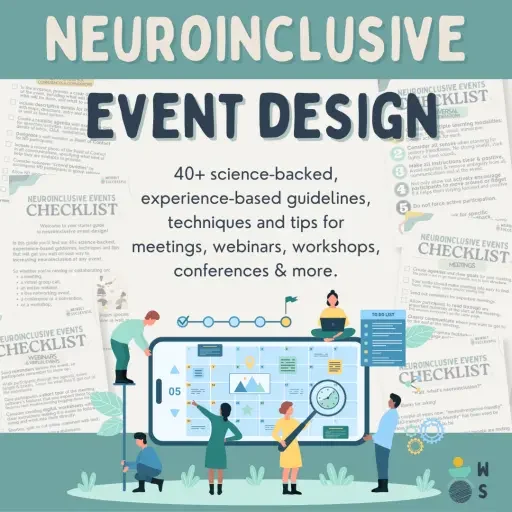
Learn more about neuroinclusive event design

Grab our Neuroinclusive Events Checklist – a handy and hyper-condensed guide full of zero- to low-cost tips and techniques for webinars, meetings, networking events and workshops.

Download now from The Library, our free resource hub.
Go to the Library
Neuroinclusive event design resource
« Back to the index

Related Questions

“How many people are neurodivergent?”

Around 15–20% of the population is neurodivergent, which is roughly 1 out of 5 — whether they know it or not.

Explore answer

“Don’t people grow out of ADHD?”

People don't grow out of ADHD. Symptoms change from external hyperactivity to internal restlessness, and life transitions often unmask previously hidden ADHD.

coping strategies diagnosis energy identity
Explore answer

“Will people judge me if they learn about my ADHD / Autism?”

People can still be mean, and your worries are valid. But research shows they're already picking up on more than you think — and that disclosure often improves how they respond, not worsens it.

disclosure self-image
Explore answer

Related Glossary Terms

double empathy

The double empathy problem is a concept in neurodiversity studies that suggests a mutual misunderstanding between neurodivergent and neurotypical individuals.

communication emotions prejudice
Learn more

curb-cut effect

The curb-cut effect refers to the phenomenon that policies initially created to serve a marginalized group end up serving a much more significant portion of society, benefiting even more people than it was originally designed for.

Learn more

unmasking

Unmasking is when you slowly learn to allow your neurodivergence to present itself and you don't try to hide yourself. However, to unmask is a privilege, as you need a safe space to do it.

relationships self-care
Learn more

intolerance of uncertainty

Intolerance of uncertainty (IU) describes the degree to which a nervous system needs predictability in order to function — not as a preference, but as a genuine operational requirement. When outcomes are unknown or plans unconfirmed, a high-IU nervous system tends to generate contingencies: running through variables, gathering information in advance, and finding it difficult to settle until enough is known. For many autistic and ADHD adults, IU runs at a higher baseline than in the general population, and shows up in everyday experiences like needing to know the plan before you can be present, finding plan changes disproportionately disruptive, or preparing carefully for situations in order to free up bandwidth to actually enjoy them. It's not about rigidity or control — it's a nervous system requesting the information it needs to work properly.

communication self-regulation stress
Learn more

Related Articles

Make Your Life Neurodivergent-friendly with the Adaptation Explorer Workbook

Neurodivergent brains don't come with universal solutions—what helps one person might not work for you at all. So if you've tried all the ADHD tips online, but nothing seems to stick, you're not alone. Here's how to discover your specific adaptations and create a life that actually works for YOUR brain. Explore your needs, what environments you work best in, what overwhelms you, and what helps you regulate.

communication self-care
Read article

ADHD & Autism on the Rise: Are There More Neurodivergent People Now?

Why it seems there are more neurodivergent people now than before, when in fact we've always been here.

Read article

Previous Post:neurospicy
Next Post:neurodivergent adaptations

About the Author

  • Weirdly Successful

    Weirdly Successful

    A 100% neurodivergent team — Adam Dobay, Livia Farkas and Nora Selmeczi — bringing together lived experience, adult education expertise, clinical training and NHS co-production to create friendly, science-backed resources that help neurodivergent adults figure out what actually works for them

    View all posts

Free Resources for Neurodivergent Adults

Get our research-backed, experience-validated strategies & guides for a neurodivergent work & life that you can adapt to what success looks like to you.

Create a free account to get your goodies!

Is the button not working? No worries!
Sometimes ad-blocks stop all pop-ups, even if they are not ads.
This might be the case if nothing happens when you click the button.
Here’s another, non-pop-up way to sign up, please try if this works!

By signing up you allow us to send you Weirdly Successful’s newsletter with practical tips, strategies, and optional training material.
You can unsubscribe any time. Our Privacy Policy makes for a great summer reading!

Weirdly Successful is a 100% neurodivergent-run non-profit, developing strategies & frameworks for neurodivergent adults.

  • E-mail
  • Instagram
  • Mastodon
  • Tumblr
  • Pinterest

DISCLAIMER: All content on this website is for informational purposes only, and does not substitute for medical advice. For medical advice, diagnosis or treatment, consult a medical professional or healthcare provider.

While we strive to represent up-to-date and scientifically accurate information, our authors are not medical professionals unless where specifically noted. All opinions are the authors’ own.

Weirdly Successful’s authors and collaborators are not liable for risks or issues
associated with using or acting upon the information on our site.

All original content Copyright © 2026 · Weirdly Successful · All Rights Reserved.

Privacy Policy