• Skip to main content
  • Skip to header right navigation
  • Skip to site footer
Weirdly Successful

Weirdly Successful

Dedicated to helping you understand, navigate and enjoy your weird & wonderful neurodivergent life.

  • About Us
    • The team
    • The mission
    • What we do
    • Events
  • Learn
    • Understanding Neurodivergence
    • Diagnosis & Assessment
    • Productivity & Planning
    • Sensory & Body
    • Emotions & Regulation
    • Health & Wellbeing
    • Work & Career
  • Free Resources
    • Latest Articles
    • Neurodivergent Glossary
      • My Glossary
    • Questions & Answers
    • Resource Library
  • Contact Us
    • Send a message
    • Book a Curiosity Call
  • LOGIN

Livia Farkas

Neurodivergent Adaptation Educator

In her free time, she enjoys stickers & planners, crochet & roller skates, and running around with her pet bunny Rumi.

Building Weirdly Successful’s Knowledge Systems

Livia is the architect behind Weirdly Successful’s knowledge infrastructure — creating the systems that help late-identified neurodivergent adults make sense of their experiences and find language for what they’ve always felt.

She created The Neurodivergent Glossary, an ever-growing encyclopaedia of neurodivergence-related terms designed to help people find answers using everyday words for their experiences—not medical jargon they haven’t yet learned. She also designed the content architecture that powers the entire website: a system that organises content by what someone is experiencing (focus, hearing, time), where they are in their journey (exploring, seeking diagnosis, recently diagnosed), and what they need to know (definitions, validation, practical strategies).

Currently, Livia is building the Weirdly Successful Learning Community: a custom-built peer support platform designed from the ground up for neurodivergent brains. Every element, from the onboarding process to the reaction buttons, has been designed to balance ADHD and Autistic accessibility needs.

Specialist Subjects

  • Neurodivergent adaptations for life and work · Dismantling harmful self-beliefs
  • Promoting self-compassion
  • Creating a life without the hustle

Background: 15 Years in Adult Education

Livia’s neurodivergent-focused work builds on 15 years as a productivity and lifestyle educator in Hungary, where she developed the frameworks, techniques, and teaching approach she now adapts for English-speaking neurodivergent audiences.

Book

That Traffic Light’s Not Getting Any Greener! (XXI. Század Kiadó, 2013; ISBN: 9786155373022) — National bestseller in Hungary, shortlisted for the Libri Golden Book Awards.

Publications

Éva Magazin (2014–2020), HVG Psychology (2019), Glamour (2019), Forbes Hungary (2017), Marie Claire Hungary (2013), Elle Hungary (2013), Cosmopolitan Hungary (2013)

TV & Radio

Livia has appeared as a productivity and lifestyle expert on Hungarian national television, including recurring segments on RTL Klub’s morning programme and appearances on TV2 and Duna World. She has been interviewed on Kossuth Rádió (Hungarian public radio), Klubrádió, and Jazzy.

Talks & Appearances

Livia has spoken at universities including the University of Debrecen, ELTE, Corvinus University, and the Balassi Institute; at professional conferences including the Mfor Marketing Conference, Digital Divas Conference, and Evolution Social Media Conference; and at a Google Ground roundtable on women in business. Her 2013 book tour included venues across Hungary and a reader meetup in London.

Awards

  • HVG GoldenBlog, Audience Award for urban:eve blog (2011, won)
  • Cosmopolitan Digital Divas, “Best Blog Design” (2012, won)
  • Glamour Women of The Year Hungary, “Blogger of the Year” (2014, nominated)

Latest from Livia

References
1↑ Long, R. (2024). Access Points: Understanding Special Interests Through Autistic Narratives. Autism in Adulthood, 7, 100–111.
2↑ Grove, R., Hoekstra, R.A., Wierda, M., & Begeer, S. (2018). Special interests and subjective wellbeing in autistic adults. Autism Research, 11.
3↑ Bross, L., Huffman, J., & Hagiwara, M. (2022). Examining the special interest areas of autistic adults with a focus on their employment and mental health outcomes. Journal of Vocational Rehabilitation, 57, 289–305.
4↑ Murray, D., Lesser, M., & Lawson, W. (2005). Attention, monotropism and the diagnostic criteria for autism. Autism, 9(2), 139–156.
5↑ Clements, C.C., Zoltowski, A.R., Yankowitz, L.D., Yerys, B.E., Schultz, R.T., & Herrington, J.D. (2018). Evaluation of the Social Motivation Hypothesis of Autism: A Systematic Review and Meta-analysis. JAMA Psychiatry, 75(8), 797–808.
6↑ Kohls, G., Schulte-Rüther, M., Nehrkorn, B., Müller, K., Fink, G.R., Kamp-Becker, I., Herpertz-Dahlmann, B., Schultz, R.T., & Konrad, K. (2013). Reward system dysfunction in autism spectrum disorders. Social Cognitive and Affective Neuroscience, 8(5), 565–572.
7↑ Caldwell-Harris, C., & Jordan, C. (2013). Systemizing and special interests: Characterizing the continuum from neurotypical to autism spectrum disorder. Learning and Individual Differences, 29, 98–105.
8↑ Edwards, H., Wright, S., Sargeant, C., Cortese, S., & Wood-Downie, H. (2023). Research Review: A systematic review and meta-analysis of sex differences in narrow constructs of restricted and repetitive behaviours and interests in autistic children, adolescents, and adults. Journal of Child Psychology and Psychiatry.
9↑ Putnam, O.C., Swisher, M., McFayden, T., Chan, D., & Harrop, C. (2025). The Role of Gender and Strong Interests in Self-Reported Camouflaging of Autistic Adults. Neurodiversity, 3.
10↑ Evans, J.A., Krumrei-Mancuso, E.J., & Rouse, S.V. (2023). What You Are Hiding Could Be Hurting You: Autistic Masking in Relation to Mental Health, Interpersonal Trauma, Authenticity, and Self-Esteem. Autism in Adulthood, 6, 229–240.
11↑ Harrop, C., Amsbary, J., Towner-Wright, S., Reichow, B., & Boyd, B.A. (2019). That's what I like: The use of circumscribed interests within interventions for individuals with autism spectrum disorder. A systematic review. Research in Autism Spectrum Disorders.
Content type: Glossary Entry📖Glossary Entry

special interests

Special interests are deeply focused areas of engagement that autistic people experience with a level of emotional investment, sustained attention, and joy that goes well beyond typical hobbies. Clinically categorised under restricted repetitive behaviours, special interests are one of the defining characteristics of autism — and for most autistic adults, they are a primary source of motivation, …

Read morespecial interests
Content type: Glossary Entry📖Glossary Entry

rigid thinking (cognitive inflexibility)

Cognitive inflexibility, also erroneously referred to as rigid thinking, is a diagnostic characteristic of autism that describes difficulty shifting between tasks, perspectives, or plans. The label captures how the trait looks from outside — but the internal experience is better understood through monotropism: a processing style that goes deep rather than wide. The depth that makes sustained …

Read morerigid thinking (cognitive inflexibility)
Content type: Glossary Entry📖Glossary Entry

synaptic pruning

Synaptic pruning is the process by which the brain refines its connections during development, removing synapses that are used less frequently while strengthening active ones. In autistic brains, this process works differently — two independent cleanup systems (the neuron's internal recycling programme and the brain's specialised immune cells) are both less aggressive, meaning significantly more …

Read moresynaptic pruning
Content type: Glossary Entry📖Glossary Entry

the mTOR pathway

The mTOR pathway is a signalling system inside every cell that regulates the balance between building new structures and recycling old ones. In autistic brains, this pathway runs hotter than typical, suppressing the cell's internal cleanup processes. Up to 58% of autism-associated genes relate to this pathway, making it a point of convergence where many different genetic routes produce similar …

Read morethe mTOR pathway
Content type: Explainer❓Explainer

“Why do I do better with a routine?”

Because routine is architecture you can rely on when everything else is wobbly or up in the air.

When you do the same things in the same order, your brain doesn't have to build the day from scratch. The route is known, the sequence is mapped, all the decisions have already been made, and you are good to go. This frees up precious cognitive resources for the things that actually need your …

Read more“Why do I do better with a routine?”
Content type: Explainer❓Explainer

“Why do I watch the same show over and over?”

Because your nervous system is doing something smart, so good for you! :)

When you rewatch a familiar show, your brain isn't processing anything new — no plot twists to manage, no unfamiliar characters to track, no sudden shifts in tone to adjust to.

Read more“Why do I watch the same show over and over?”
Content type: Glossary Entry📖Glossary Entry

intolerance of uncertainty

Intolerance of uncertainty (IU) describes the degree to which a nervous system needs predictability in order to function — not as a preference, but as a genuine operational requirement. When outcomes are unknown or plans unconfirmed, a high-IU nervous system tends to generate contingencies: running through variables, gathering information in advance, and finding it difficult to settle until enough …

Read moreintolerance of uncertainty
Content type: Glossary Entry📖Glossary Entry

restricted repetitive behaviours (RRBs)

Restricted Repetitive Behaviours (RRBs) is the clinical term for a broad group of autistic traits including stimming, echolalia, routines, persistent interests, and sensory sensitivities. Despite the pathologising name, these patterns serve real purposes — self-regulation, cognitive energy conservation, and genuine enjoyment. They are how an autistic nervous system manages a world that doesn't …

Read morerestricted repetitive behaviours (RRBs)
Content type: Glossary Entry📖Glossary Entry

Rejection Sensitivity Dysphoria (RSD)

Rejection Sensitivity Dysphoria (RSD) is an intense emotional and physical response to perceived rejection, criticism, or the fear of falling short — experienced by many neurodivergent people. The hot flash of shame, the spiral of "what did I do wrong," the doomsday scenarios building while the other person is simply answering their front door — these are recognisable experiences for many people …

Read moreRejection Sensitivity Dysphoria (RSD)
Content type: Explainer❓Explainer

“Is fidgeting and stimming the same thing?”

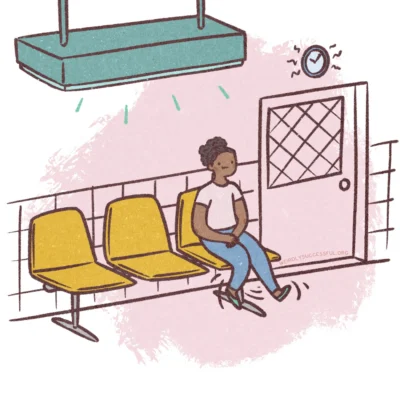
Fidgeting is similar to stimming, but they serve different purposes. While stimming tends to function as emotional regulation (a way to manage overwhelming feelings or sensory input), fidgeting more often serves focus regulation and energy discharge. The movements might look the same from the outside, but the internal experience and function can be quite different.

Read more“Is fidgeting and stimming the same thing?”
Content type: Glossary Entry📖Glossary Entry

fidgeting

Fidgeting involves small, often unconscious movements—bouncing your leg, tapping your fingers, clicking a pen, doodling, twirling your hair. These movements help regulate focus and discharge energy, particularly for people with ADHD. Fidgeting provides the sensory input your brain needs to stay alert and engaged, especially during tasks that don't provide enough stimulation on their own. It's …

Read morefidgeting
Content type: Explainer❓Explainer

“Why do people fidget when they are hyperactive?”

Fidgeting serves as an involuntary mechanism for self-regulating attention and enhancing alertness, especially during tasks perceived as cognitively demanding (hard to do) or monotonous (i.e. boring and repetitive).

Read more“Why do people fidget when they are hyperactive?”
  • Previous
  • Page 1
  • Page 2
  • Page 3
  • Page 4
  • Page 5
  • Interim pages omitted …
  • Page 10
  • Next

Free Resources for Neurodivergent Adults

Get our research-backed, experience-validated strategies & guides for a neurodivergent work & life that you can adapt to what success looks like to you.

Create a free account to get your goodies!

Is the button not working? No worries!
Sometimes ad-blocks stop all pop-ups, even if they are not ads.
This might be the case if nothing happens when you click the button.
Here’s another, non-pop-up way to sign up, please try if this works!

By signing up you allow us to send you Weirdly Successful’s newsletter with practical tips, strategies, and optional training material.
You can unsubscribe any time. Our Privacy Policy makes for a great summer reading!

Weirdly Successful is a 100% neurodivergent-run non-profit, developing strategies & frameworks for neurodivergent adults.

  • E-mail
  • Instagram
  • Mastodon
  • Tumblr
  • Pinterest

DISCLAIMER: All content on this website is for informational purposes only, and does not substitute for medical advice. For medical advice, diagnosis or treatment, consult a medical professional or healthcare provider.

While we strive to represent up-to-date and scientifically accurate information, our authors are not medical professionals unless where specifically noted. All opinions are the authors’ own.

Weirdly Successful’s authors and collaborators are not liable for risks or issues
associated with using or acting upon the information on our site.

All original content Copyright © 2026 · Weirdly Successful · All Rights Reserved.

Privacy Policy