• Skip to main content
  • Skip to header right navigation
  • Skip to site footer
Weirdly Successful

Weirdly Successful

Dedicated to helping you understand, navigate and enjoy your weird & wonderful neurodivergent life.

  • About Us
    • The team
    • The mission
    • What we do
    • Events
  • Learn
    • Understanding Neurodivergence
    • Diagnosis & Assessment
    • Productivity & Planning
    • Sensory & Body
    • Emotions & Regulation
    • Health & Wellbeing
    • Work & Career
  • Free Resources
    • Latest Articles
    • Neurodivergent Glossary
    • Questions & Answers
    • Resource Library
  • Contact Us
    • Send a message
    • Book a Curiosity Call

unmasking

relationships self-care society support
by
Weirdly Successful
Weirdly Successful (author)  

First published: 28 June, 2023 | Last edited: 12 January, 2026 || 📚🕒 Reading Time: < 1 minute ||

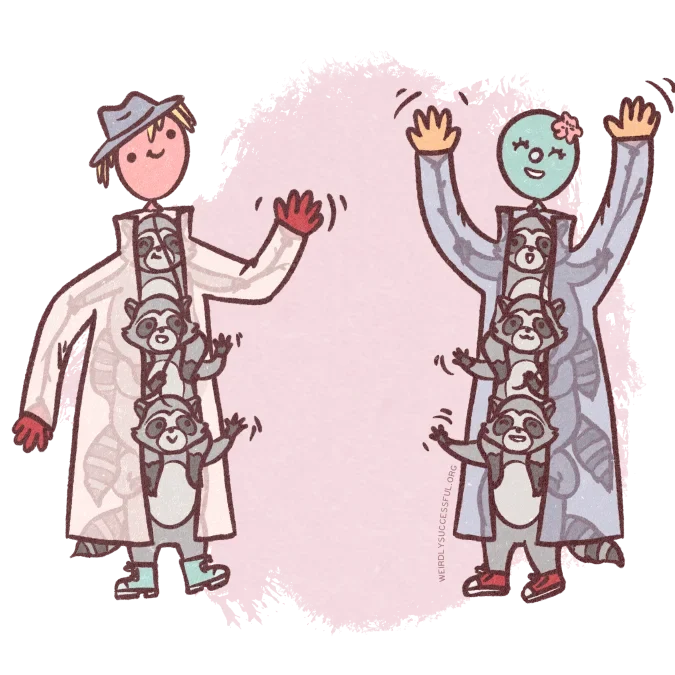
Unmasking is the process through which you slowly learn to allow your neurodivergence to present itself, no longer trying to hide yourself.

In this way, unmasking is a part of unlearning behaviours and thought patterns that we were taught we must abide by in order to be accepted by the neurotypical population.

Unmasking is not a binary on/off switch. As everyone’s masking is made up of many different elements picked up from various sources, unmasking is a granular process.

To unmask is a privilege. You need a safe space to do it, and not everyone has access to communities where they don’t have to pretend and are allowed to stop masking.

An important part of unmasking is learning which of your neurodivergent traits are safe to present across which environments.

Over time, you find new ways in which you have inadvertently been masking, and then learn whether and how much you can unmask that. In this way, unmasking is not a one-and-done event, but is more like a lifelong practice of awareness and healing.

Unmasking should be a regular part of neurodivergent self-care and is crucial to avoid or heal from autistic burnout.

Related Questions

"Don't people grow out of ADHD?"

coping strategies diagnosis energy identity
Explore answer

"I have tried traditional "self-care" activities, and they don't do anything for me. What am I doing wrong?"

coping strategies energy self-regulation sensory
Explore answer

"Why do I do better with a routine?"

energy focus motivation self-regulation
Explore answer

"Why do I watch the same show over and over?"

coping strategies energy self-regulation sensory
Explore answer

"Doesn't ADHD mostly affect boys?"

diagnosis identity prejudice
Explore answer

"Is ADHD caused by trauma?"

diagnosis harm identity prejudice
Explore answer

"I don't want to become my label and use my neurodivergence as an excuse"

diagnosis identity self-image
Explore answer

"What can a neurodivergent diagnosis give me if I got this far on my own?"

coping strategies diagnosis identity self-image
Explore answer
« Back to the index

Related Terms

decompressing

Decompressing refers to engaging in activities or behaviours that allow a person to relax, unwind, and alleviate stress or sensory overload. This term is particularly significant in the neurodivergent community as we often experience heightened sensitivity to environmental stimuli, leading to increased stress and anxiety levels. Making sure to have time to decompress after especially taxing events is an essential part of self-care.

Learn more
self-regulation sensory
double empathy

The double empathy problem is a concept in neurodiversity studies that suggests a mutual misunderstanding between neurodivergent and neurotypical individuals.

Learn more
communication emotions prejudice
deep pressure

Deep pressure is a natural sensory need where firm, consistent pressure (like heavy blankets or tight hugs) helps tension melt away from your body. Many people naturally seek this through things like snug clothing or curling up under blankets - it's your nervous system's way of finding calm and comfort.

Learn more
self-regulation sensory touch
curb-cut effect

The curb-cut effect refers to the phenomenon that policies initially created to serve a marginalized group end up serving a much more significant portion of society, benefiting even more people than it was originally designed for.

Learn more
neuroaffirming

Neuroaffirming or neuro-affirmative refers to practices, approaches, or environments that recognize and affirm the neurodiversity of society and the neurodivergence of individuals.

Learn more
intolerance of uncertainty

Intolerance of uncertainty (IU) describes the degree to which a nervous system needs predictability in order to function — not as a preference, but as a genuine operational requirement. When outcomes are unknown or plans unconfirmed, a high-IU nervous system tends to generate contingencies: running through variables, gathering information in advance, and finding it difficult to settle until enough is known. For many autistic and ADHD adults, IU runs at a higher baseline than in the general population, and shows up in everyday experiences like needing to know the plan before you can be present, finding plan changes disproportionately disruptive, or preparing carefully for situations in order to free up bandwidth to actually enjoy them. It's not about rigidity or control — it's a nervous system requesting the information it needs to work properly.

Learn more
communication self-regulation stress
Previous Post:high-masking
Next Post:PMDD

About the Author

  • Weirdly Successful

    Weirdly Successful

    A 100% neurodivergent team — Adam Dobay, Livia Farkas and Nora Selmeczi — bringing together lived experience, adult education expertise, clinical training and NHS co-production to create friendly, science-backed resources that help neurodivergent adults figure out what actually works for them

    View all posts

Free Resources for Neurodivergent Adults

Get our research-backed, experience-validated strategies & guides for a neurodivergent work & life that you can adapt to what success looks like to you.

Create a free account to get your goodies!

Is the button not working? No worries!
Sometimes ad-blocks stop all pop-ups, even if they are not ads.
This might be the case if nothing happens when you click the button.
Here’s another, non-pop-up way to sign up, please try if this works!

By signing up you allow us to send you Weirdly Successful’s newsletter with practical tips, strategies, and optional training material.
You can unsubscribe any time. Our Privacy Policy makes for a great summer reading!

Weirdly Successful is a 100% neurodivergent-run non-profit, developing strategies & frameworks for neurodivergent adults.

  • E-mail
  • Instagram
  • Mastodon
  • Tumblr
  • Pinterest

DISCLAIMER: All content on this website is for informational purposes only, and does not substitute for medical advice. For medical advice, diagnosis or treatment, consult a medical professional or healthcare provider.

While we strive to represent up-to-date and scientifically accurate information, our authors are not medical professionals unless where specifically noted. All opinions are the authors’ own.

Weirdly Successful’s authors and collaborators are not liable for risks or issues
associated with using or acting upon the information on our site.

All original content Copyright © 2026 · Weirdly Successful · All Rights Reserved.

Privacy Policy