
• Skip to main content
  • Skip to header right navigation
  • Skip to site footer
Weirdly Successful

Weirdly Successful

Dedicated to helping you understand, navigate and enjoy your weird & wonderful neurodivergent life.

  • About Us
    • The team
    • The mission
    • What we do
    • Events
  • Learn
    • Understanding Neurodivergence
    • Diagnosis & Assessment
    • Productivity & Planning
    • Sensory & Body
    • Emotions & Regulation
    • Health & Wellbeing
    • Work & Career
  • Free Resources
    • Latest Articles
    • Neurodivergent Glossary
    • Resource Library
  • Contact Us
    • Send a message
    • Book a Curiosity Call

alexithymia

bodily sensations eating emotions hunger pain
by
Livia Farkas (author)  

First published: 2 August, 2023 | Last edited: 12 January, 2026 || 📚🕒 Reading Time: < 1 minute

Alexithymia is difficulty assigning names to feelings, describing them to others or talking about them. It is considered a separate neuropsychological condition but has significant overlaps with autism.

This term is also known as:
emotional blindness

« Back to the index

Related Terms

interoception

Interoception is the ability to notice and identify feelings inside one's body, like thirst or hunger. It also includes the ability to notice and regulate temperature changes or notice pain.

Learn more
sleep
Sensory processing difficulties

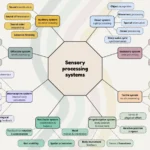
Sensory processing difficulties are a group of traits associated with neurodivergence. They're part of the wider group of sensory processing differences, meaning all the ways neurodivergent brains handle sensory information differently from neurotypical peers. Any of the brain's 8 sensory processing systems can be affected by processing difficulties.

Learn more
hearing sensory touch vision
Sensory Processing Disorder (SPD)

Sensory Processing Disorder (SPD) is a potential grouping of sensory processing difficulties. As individual sensory processing difficulties are spread across a wide range of diagnoses, SPD is often used as a shorthand to describe significant neurodivergence-related sensory issues that are persistent in a person's life and limit their participation in everyday life, regardless of what diagnosis they would officially belong to.

Learn more
hearing information sensory
sensory overwhelm

A feeling of immense distress, a sensory overwhelm / autistic overwhelm is a strong reaction to stimuli caused by the compounded effects of stress, exhaustion, lack of safety, a sense of danger, unmet needs, too much information, noise, sights or sounds, smells or touch.

Learn more
hearing information light sound touch
restriction

Restriction means being prevented from moving freely or being confined against your will. It can include being held down, trapped, or having your movement controlled by others. This is particularly important for neurodivergent people, who have historically faced harmful practices where restriction was used to stop stimming, force compliance, or 'manage' sensory overload.

Learn more
harm prejudice touch
flat affect

Flat affect is an autistic speech pattern that can include fewer facial expressions, reduced eye contact and speech that others might describe as 'monotone'. While these might be be interpreted as diminished emotional response, they actually reflect a different way of processing and expressing emotions. The intensity can vary with stress or cognitive load, and it often indicates deep focus rather than disinterest.

Learn more
communication speech voice
Previous Post:curb-cut effect
Next Post:interoception

About the Author

  • Livia Farkas

    Livia is a Neurodivergent Adaptation Educator with a sharp sense for simplifying complex ideas. Since 2008, she's developed 294 distinct techniques catered to the needs of clients. A total of 5058 alumni have enrolled in one or more of the 8 online courses she co-developed with Adam, offering neurodivergence-inclusive frameworks for time management, goal setting, self-care for mental health, and small-business management.
    Her life goal is to be a walking permission slip for neurodivergent adults.
    In her free time, she enjoys stickers & planners, crochet & roller skates, and running around with her pet bunny Rumi.

    View all posts

Free Resources for Neurodivergent Adults

Get our research-backed, experience-validated strategies & guides for a neurodivergent work & life that you can adapt to what success looks like to you.

Create a free account to get your goodies!

Is the button not working? No worries!
Sometimes ad-blocks stop all pop-ups, even if they are not ads.
This might be the case if nothing happens when you click the button.
Here’s another, non-pop-up way to sign up, please try if this works!

By signing up you allow us to send you Weirdly Successful’s newsletter with practical tips, strategies, and optional training material.
You can unsubscribe any time. Our Privacy Policy makes for a great summer reading!

Weirdly Successful is a 100% neurodivergent-run non-profit, developing strategies & frameworks for neurodivergent adults.

  • E-mail
  • Instagram
  • Mastodon
  • Tumblr
  • Pinterest

DISCLAIMER: All content on this website is for informational purposes only, and does not substitute for medical advice. For medical advice, diagnosis or treatment, consult a medical professional or healthcare provider.

While we strive to represent up-to-date and scientifically accurate information, our authors are not medical professionals unless where specifically noted. All opinions are the authors’ own.

Weirdly Successful’s authors and collaborators are not liable for risks or issues
associated with using or acting upon the information on our site.

All original content Copyright © 2026 · Weirdly Successful · All Rights Reserved.

Privacy Policy