


It is totally valid to resist being put into a box or being reduced to a diagnosis.
But I suggest considering this:
Whether you like it or not, you already have labels, given to you by other people: lazy, scatterbrain, kooky, weird, slob, messy…
You might have heard it from parents, teachers and fellow humans for decades.
You also might have internalised many of them – telling yourself over and over again how undeserving you are, you just need to try harder, punishing yourself for things you are born with, and feeling shame over your entire existence. If only you’d just be better at this thing called “being human”!
As soon as you have clarity on why you are the way you are and what exactly this means for you specifically, this chapter is over.

Calling things what they are is not boxing them in, but giving your clarity
You know that thing that sticks out of the middle of your face is called a nose. That’s a label. Still, knowing what it’s called doesn’t mean you have to buy a NOSE PERSON T-shirt and make it your entire personality. It doesn’t suddenly define you once you’ve learnt its name. But it makes it easier to communicate about it when you choose to, and when you need to.
This is true for so many things in ADHD, Autism and other neurodivergent conditions. Not just knowing the name of the condition itself, but being able to learn what your individual traits are, how they interact, and what to look out for going forward.
Once you know what something is called, how it’s not “defective mayonnaise” but body lotion, you have knowledge. You have power. You have agency. You have the accurate context and the appropriate tools to support yourself.
One of the main benefits of knowing you are neurodivergent is that you can finally stop forcing neurotypical solutions on yourself and shame yourself to fit the mould. You can let go of brute forcing into “normalcy” (whatever even is that).
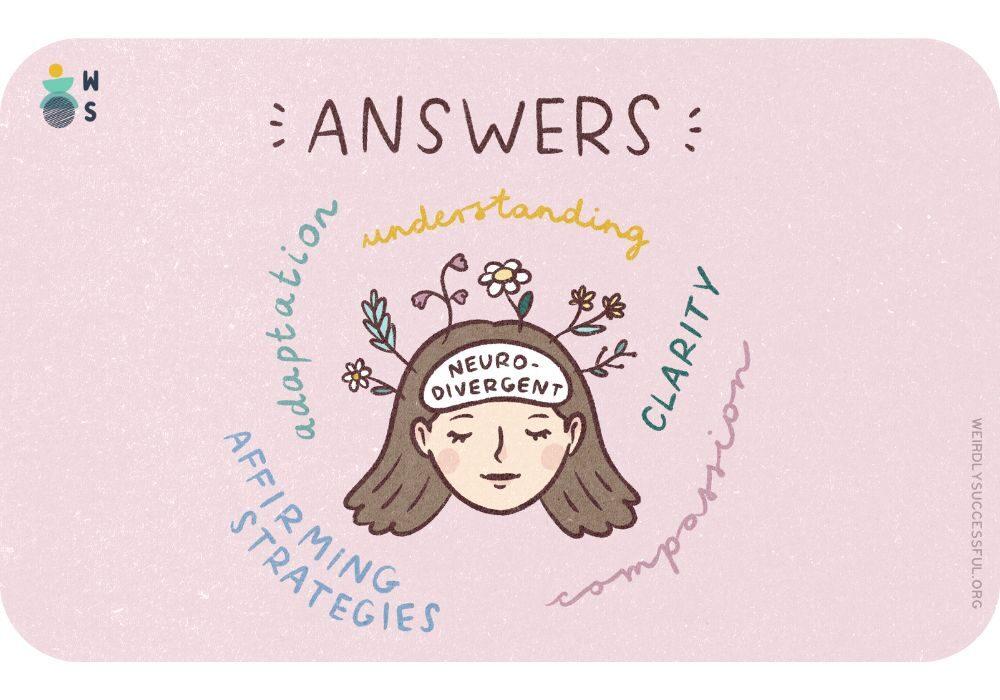
Having confirmation that you’re neurodivergent can become a key to supporting yourself.
Once you know that a bunch of the things you experience in your life are officially labelled as, for example, ‘ADHD’, you now have context for the individual things within that label:
- you’ll no longer be searching for ‘how to stop being lazy’, but instead learning about executive dysfunction, what your daily patterns of mental energy are, what your peak times are, and what strategies can improve it
- instead of trying to be ‘less sensitive’, you’ll be exploring sensory overwhelm and learning about your triggers and adaptation needs.
- instead of trying to ‘just get things done’, you’ll be looking into neurodivergent-friendly organisation tools and aids
- what people labelled as “quick to anger” you can now identify as overstimulation caused by noisy and crowded commutes. And suddenly, you have a different framework for how to address or even prevent the outcome in an actually affirming way.
With your labels neutralised, they can act as informative signposts, you can make informed choices on trying out methods that align more with what you actually need for your brain to work, and not trying to contort your brain into a normal shape like it’s some kind of balloon animal.
And who knows, maybe after a while, you can even reclaim previously negative labels as positive ones. (We’re doing that with weird.)
At the end of the day, labels can be a neutral shorthand. Use them when they’re important or useful for the context you’re in. You don’t need to worry about them otherwise. The difference is, this label can be one you choose for yourself. It is not imposed on you out of frustration, misunderstanding, judgment, or meanness. It can be a representation of your new understanding of how you work and what you need.
« Back to the index
 “What can a neurodivergent diagnosis give me if I got this far on my own?”