
• Skip to main content
  • Skip to header right navigation
  • Skip to site footer

There are lots of winter holiday planners out there.

Not a lot of them are particularly ADHD, Autism or neurodivergence-friendly, though!

So we created this one to reduce holiday stress, hassle and overwhelm so you can:

  • regain a sense of calm,
  • practice being kind to yourself, and
  • feel that you can be you.

Waiting for you on the pages ahead is a combination of guided self-care and planning pages to help you get things out of your head & neatly organised, freeing up mental headspace to find the accommodations you need to enjoy the year-end.

And you won’t be alone – we’ll be there with you throughout with tips and suggestions.

We hope this planner gives you the ability to take a big, full breath again and exhale with joy and contentment.

Here’s to a splendid festive season!

Stay weird,

Livia, Adam & Nora

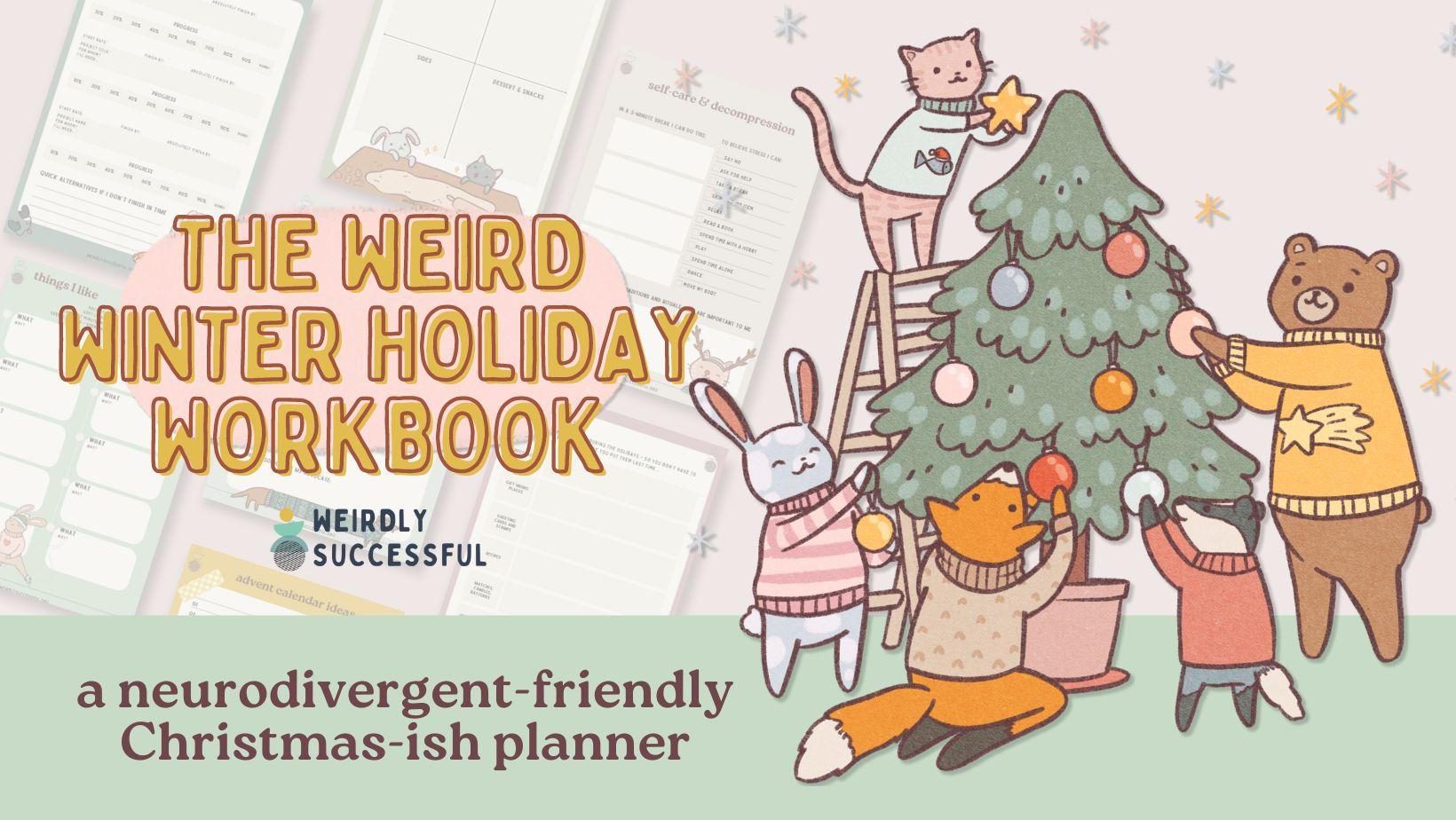
Download the Weird Winter Holiday Workbook

Grab our neurodivergent-friendly Christmas-ish planner – 36 pages of worksheets for planning, ideas, tasks, self-care, adaptation needs and boundary setting, to make this season a bit more festive and a bit less hectic.

Download now from The Library, our free resource hub.

Go to The Library

What’s in the workbook?

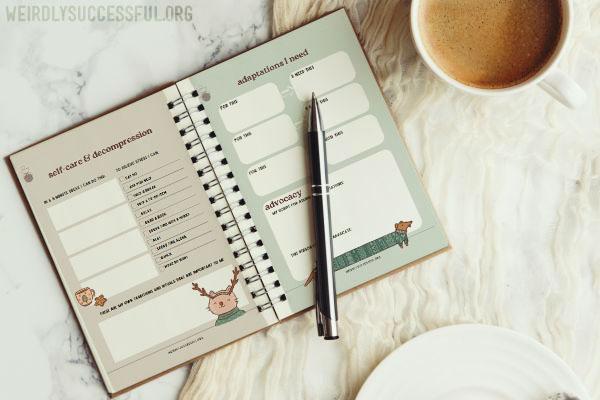
The first part is a series of thematic planning pages that support you in this often hectic time.

  • You can detail your sensory toolkit,
  • list your adaptation needs,
  • prepare strategies for uncomfortable situations before they happen, like setting boundaries
  • and even create a support page for an advocate so they know how they can help you.

We want to set you up for success and minimise those pesky, superfluous to-dos, so permission granted to be selective. Work only with the pages that are most important to your well-being, and feel free to skip the rest.
The second part is all about lists and ideas – these planner pages help you explore what you want from the festive season, whether it’s decorations, gift ideas, meal plans or holiday cards.

  • You can use the calendar pages as a classic diary to schedule activities and deadlines: When are you going gift shopping? When is that cute festive after-work taking place? When do you need to post the greeting cards and when are you picking them out?
  • You can track your DIY present progress, preparation tasks and gift ideas, and focus on the things that are most important to you during this season.
  • These pages give you an overview of the most important milestones which you can later break down into ideas and preparatory tasks.
  • We also included a colouring page just for fun. 🙂

Download yours from the Library

Related Terms

pattern recognition in autism

Pattern recognition is a thinking style common in autistic people, involving a tendency to notice underlying structures, connections, and regularities across many areas of life — sensory, social, systemic, and practical. Research supports enhanced visual and perceptual pattern detection in autism, and many autistic adults describe this extending into how they solve problems, read people, predict outcomes, and make sense of the world. Pattern recognition varies enormously between individuals in which domains it shows up, and works best when the data is consistent and rule-governed — making it a genuine strength in many contexts, while less effective in the noisy, context-dependent domain of real-time social interaction.

communication focus
Learn more

rigid thinking (cognitive inflexibility)

Cognitive inflexibility, also erroneously referred to as rigid thinking, is a diagnostic characteristic of autism that describes difficulty shifting between tasks, perspectives, or plans. The label captures how the trait looks from outside — but the internal experience is better understood through monotropism: a processing style that goes deep rather than wide. The depth that makes sustained focus, thoroughness, and reliability possible is the same depth that makes switching costly. The difficulty and the strength are the same mechanism.

communication emotions energy focus motivation thoughts
Learn more

intolerance of uncertainty

Intolerance of uncertainty (IU) describes the degree to which a nervous system needs predictability in order to function — not as a preference, but as a genuine operational requirement. When outcomes are unknown or plans unconfirmed, a high-IU nervous system tends to generate contingencies: running through variables, gathering information in advance, and finding it difficult to settle until enough is known. For many autistic and ADHD adults, IU runs at a higher baseline than in the general population, and shows up in everyday experiences like needing to know the plan before you can be present, finding plan changes disproportionately disruptive, or preparing carefully for situations in order to free up bandwidth to actually enjoy them. It's not about rigidity or control — it's a nervous system requesting the information it needs to work properly.

communication self-regulation stress support
Learn more

impulsivity

Impulsivity in ADHD is characterized by a shortened pause between impulse and action: a bright flash that leads immediately to behaviour before you can fully consider it. Impulsivity shows up in different forms: verbal (blurting out, interrupting), emotional (expressing strong feelings immediately), decision-making (choosing immediate rewards over delayed ones), and motor (acting on physical urges).

communication decisions self-regulation
Learn more

inertia

Inertia is the experience of being unable to start (or stop) an activity despite wanting to. It's a common neurodivergent experience related to executive function, and not caused by laziness, procrastination or lack of motivation. Like a car without fuel, no amount of pressing the gas pedal will help when the resources needed for action aren't available.

energy focus motivation
Learn more

cognitive load

Cognitive load refers to the total amount of mental effort being used at any given time. For neurodivergent people, activities that others might find automatic (like maintaining expected facial expressions or processing background noise) can significantly increase cognitive load.

focus information thoughts
Learn more

Related Questions

“Why do I do better with a routine?”

energy focus motivation self-regulation support
Explore answer

“How can I recognize when I’m about to make an impulsive decision?”

decisions self-regulation
Explore answer

“Why do traditional productivity methods make me feel worse instead of better?”

coping strategies focus productivity
Explore answer
Previous Post:I didn’t think I was neurodivergent – until I learned what it really means
Next Post:ADHD & Autism on the Rise: Are There More Neurodivergent People Now?

Reader Interactions

Leave a Reply Cancel reply

Your email address will not be published. Required fields are marked *

Free Resources for Neurodivergent Adults

Get our research-backed, experience-validated strategies & guides for a neurodivergent work & life that you can adapt to what success looks like to you.

Create a free account to get your goodies!

Is the button not working? No worries!
Sometimes ad-blocks stop all pop-ups, even if they are not ads.
This might be the case if nothing happens when you click the button.
Here’s another, non-pop-up way to sign up, please try if this works!

By signing up you allow us to send you Weirdly Successful’s newsletter with practical tips, strategies, and optional training material.
You can unsubscribe any time. Our Privacy Policy makes for a great summer reading!

Weirdly Successful is a 100% neurodivergent-run non-profit, developing strategies & frameworks for neurodivergent adults.

  • E-mail
  • Instagram
  • Mastodon
  • Tumblr
  • Pinterest

DISCLAIMER: All content on this website is for informational purposes only, and does not substitute for medical advice. For medical advice, diagnosis or treatment, consult a medical professional or healthcare provider.

While we strive to represent up-to-date and scientifically accurate information, our authors are not medical professionals unless where specifically noted. All opinions are the authors’ own.

Weirdly Successful’s authors and collaborators are not liable for risks or issues
associated with using or acting upon the information on our site.

All original content Copyright © 2026 · Weirdly Successful · All Rights Reserved.

Privacy Policy